Autonomous Supply Chain How AI Turns Data into Decisions

Volatility is one of the biggest challenges facing today’s supply chains. From inflation and labor shortages to geopolitical tensions and unpredictable transportation delays, businesses are facing disruptions that can quickly impact operations. As a result, traditional Supply Chain Management models that still rely heavily on manual processes are no longer enough to keep pace with rapidly changing business environments.

In our previous article, we explored Autonomous Finance, an emerging AI trend that is transforming the finance function. This time, I AM Consulting takes a closer look at another critical area Autonomous Supply Chain.

Autonomous Supply Chain is transforming the way organizations manage operations and execute business strategies by enabling them to sense, predict, decide, and respond to changes faster and more accurately.

What Is an Autonomous Supply Chain?

Autonomous Supply Chain is an approach to Supply Chain Management that brings together AI, Business Data, Applications, and Automation to connect processes across the entire supply chain from Planning, Procurement, and Manufacturing to Logistics and Asset Management.

Instead of operating as separate functions, these processes can work together more intelligently, enabling the supply chain to analyze information, support decision-making, and adapt to changing conditions with greater levels of automation.

The key is not simply Automation, but Orchestration connecting People + Processes + Technology so they can operate as an integrated system.

By reducing Data Silos and creating End-to-End Supply Chain Visibility, organizations can respond to changes faster and make better-informed decisions.

Rather than requiring people to manually coordinate every step, an Autonomous Supply Chain enables Supply Chain Orchestration from upstream to downstream, helping businesses respond to disruptions and changing market conditions in a more timely and effective way.

4 Key Capabilities of an Autonomous Supply Chain

1. Greater Agility and Faster Decision-Making

An AI-driven Supply Chain can continuously adapt to changing conditions, connect operations across different functions, and help organizations deliver products and services with greater confidence.

By using AI to analyze data and identify potential issues, businesses can accelerate decision-making while improving their ability to respond to supply and demand fluctuations.

2. More Automated and Reliable Supply Chain Operations

By combining AI, Business Data, and Applications, organizations can orchestrate workflows and increase Supply Chain Automation.

This enables more decision-making processes to be automated, reducing the amount of manual work required to coordinate operations while improving consistency and operational efficiency.

3. End-to-End Supply Chain Visibility

Strong Supply Chain Visibility gives organizations a clearer view of what is happening across the entire supply chain. by connecting information across internal functions and external partners, businesses can reduce Operational Silos, improve data transparency, and gain an End-to-End, Real-Time view of supply chain operations.

This visibility provides decision-makers with the context they need to identify risks, understand their potential impact, and take action before disruptions escalate.

4. Faster and More Accurate Adaptation

An Autonomous Supply Chain helps organizations prepare for Supply Chain Disruptions and changes in customer demand through AI-driven recommendations and automated process adjustments.

As a result, organizations can respond to changes faster and more accurately while maintaining greater control over operations. This improves both Supply Chain Agility and overall Business Continuity.

How AI Agents Are Changing Supply Chain Management

One of the most important technologies behind the Autonomous Supply Chain is Agentic AI and the use of AI Agents. Unlike traditional AI systems that primarily provide answers or insights, an AI Agent can receive an Objective or Task, understand its context, coordinate with other systems, and execute parts of a workflow to achieve a specific goal.

SAP is applying this concept through Joule Agents and Joule Assistants across different areas of Supply Chain Management, helping transform previously disconnected data and processes into more Connected Workflows.

1. Planning Assistant

Working with SAP IBP (Integrated Business Planning), Planning Assistants can support Demand Sensing and Supply Optimization.

They can help Planners create, adjust, and review plans more quickly and accurately, while leveraging Predictive Insights and coordinating AI Agents to support planning and data-driven decision-making.

2. Logistics Assistant

Working with SAP TM (Transportation Management) and SAP EWM (Extended Warehouse Management), Logistics Assistants can help coordinate activities across Transportation, Warehousing, and Fulfillment in real time.

This enables teams to monitor changing logistics conditions and respond more quickly to transportation or fulfillment issues.

3. Manufacturing Assistant

Within SAP Digital Manufacturing (DM) or SAP S/4HANA Manufacturing, AI can help identify potential disruptions and assess their impact on Materials, Inventory, Quality, and Workforce.

The system can then recommend a Next Best Action, helping teams improve production efficiency through AI-supported decision-making and execution.

4. Product Design Assistant

Working with solutions across SAP PLM (Product Lifecycle Management) and SAP S/4HANA (R&D / Engineering), Product Design Assistants can help reduce the time from product concept to production.

By coordinating AI Agents to automate selected design-related activities, organizations can accelerate product development and improve decision-making throughout the product lifecycle.

5. Asset Operations Assistant

Working with SAP APM (Asset Performance Management), Asset Operations Assistants can coordinate AI Agents across Reliability, Maintenance Planning, Scheduling, and Execution.

Asset data and operational signals can be used to prioritize maintenance activities, allocate resources, and feed execution results back into the process for continuous improvement of asset performance.

Together, these examples demonstrate that an Autonomous Supply Chain is not created by AI or Automation alone.

It is built by connecting AI, Data, People, and Business Processes so that the supply chain can sense what is happening, coordinate activities, support decision-making, and respond to changes more quickly.

3 Business Outcomes of an Autonomous Supply Chain

Connecting systems, data, and processes across the supply chain can generate measurable business outcomes across areas such as Visibility, Efficiency, Inventory Management, and Operational Performance.

1. Up to 4x Greater Data Visibility

Connecting data and systems can provide organizations with a more comprehensive view of supply chain conditions, enabling teams to understand what is happening and make decisions faster.

2. Up to 80% Less Time Spent on Supply Chain Operations

Automating repetitive processes and reducing manual coordination can help organizations minimize operational workloads and improve process efficiency.

3. Up to 30% Reduction in Days Inventory Outstanding

Improved visibility and smarter decision-making can help organizations optimize Inventory Management and use working capital tied up in inventory more efficiently.

Autonomous Supply Chain in Action: Connecting Systems to Respond to Disruption

A sudden storm causes a vessel carrying a critical shipment of imported raw materials to be delayed by five days. Under a traditional supply chain model, the Procurement team may only become aware of the delay after receiving an update from the logistics provider. By the time the information reaches the factory and production teams, the disruption could already affect the production schedule. With an Autonomous Supply Chain, the response can happen much earlier.

1. Detect the Risk Immediately

The Logistics Assistant detects the vessel delay and analyzes it against current inventory levels. The system identifies that the delay could affect the production schedule for the following week.

2. Automatically Identify an Alternative

The system sends the signal to the Manufacturing Assistant, which identifies alternative production orders that have the required materials already available. The production schedule can then be adjusted to prioritize those orders.

3. Keep People in Control

The system prepares the recommended Next Best Action and presents the alternative plan to the Planner for review and approval.

Instead of spending hours making phone calls, checking spreadsheets, and organizing urgent cross-functional meetings, the Planner can review the recommendation and approve the action with minimal manual effort.

Production can continue with minimal disruption, helping the organization move toward Zero Downtime while reducing the time required for cross-functional coordination.

An Autonomous Supply Chain creates value beyond AI and Automation. It helps organizations improve Supply Chain Visibility, reduce operational workloads, optimize Inventory Management, and accelerate decision-making all of which are critical to building long-term Supply Chain Resilience and gaining a sustainable Competitive Advantage.

Our experts help businesses strengthen their capabilities across Data, Business Applications, AI, and Digital Transformation, enabling more agile, connected, and intelligent operations.

Build a smarter, more resilient Autonomous Supply Chain and prepare your organization for the future with I AM Consulting.

Autonomous HCM AI That Goes Beyond Traditional HR

As AI becomes increasingly embedded across every part of the organization, including Human Resources (HR), which works directly with people, the question is no longer whether AI will replace humans, but rather how we can use AI to help people become more capable and grow alongside the organization.

Previously, AI primarily helped answer questions, screen candidates, or summarize reports. Today, SAP is taking HR a step further with Autonomous HCM , transforming AI from a task-supporting tool into an intelligent assistant capable of analyzing data and supporting more complex people-related decisions.

In our previous articles, we explored the concept of the Autonomous Enterprise and one of its key components, Autonomous Finance. This time, I AM Consulting takes a closer look at another critical element of an organization.

Through the concept of Autonomous HCM, technology is transforming Human Resources from a function that relies heavily on manual processes into a more automated, data-driven function that can analyze information and support HR decision-making more effectively.

What Is Autonomous HCM?

Autonomous HCM, or Autonomous Human Capital Management, is an approach to human capital management that combines AI, Machine Learning, and Automation with end-to-end HR processes.

Its goal is to reduce repetitive work, analyze relevant information, and coordinate activities across different stages of HR processes so that they can operate more continuously and efficiently, while maintaining clear governance and keeping humans in control of critical decisions.

AI in Autonomous HCM therefore goes beyond simply answering questions like a chatbot. It can gather relevant information, determine which tools or resources are appropriate, and help execute processes involving multiple steps.

Autonomous HCM also connects employee data, skills, and business needs, allowing organizations to identify workforce trends, personalize learning and career development, and make it easier to operate in accordance with relevant policies and requirements.

The 3 Key Pillars of Autonomous HCM

SAP’s built around three key elements that connect people, data, and HR processes.

1. Powerful Agentic Experiences: AI That Understands Context and Handles Multi-Step Tasks

AI for HR is no longer limited to answering questions like a traditional chatbot. It can understand what users are trying to accomplish, gather relevant information, and coordinate multiple steps to move a process forward.

Tasks that previously required employees to search for information or switch between multiple systems can therefore be completed more efficiently.

This helps reduce administrative workloads and gives HR teams more time to focus on strategic priorities such as Workforce Strategy, Talent Development, and Employee Experience.

2. Trusted People Data: Effective AI Starts with Reliable People Data

The quality of AI-driven analysis and recommendations depends heavily on the quality of the underlying data.

Autonomous HCM therefore places strong emphasis on maintaining employee and skills data that is accurate, structured, and up to date, ensuring that HR processes across the organization can work from consistent sources of information.

When this data is systematically connected, AI can provide more accurate insights into workforce situations. HR teams and business leaders can work from a shared view of people data, enabling them to make decisions with greater confidence.

3. Connected Applications: Connecting HR Processes into One Integrated System

Human capital management covers a wide range of processes, from Core HR and Payroll to Recruitment, Learning, Performance Management, and Workforce Management.

Each of these processes generates data that is connected to different stages of the employee journey.

SAP therefore designs these applications to connect and exchange data, allowing AI to gain a more complete view of the workforce and analyze information continuously rather than evaluating each HR system in isolation.

4 AI Assistants That Are Transforming HR

SAP is introducing AI Assistants across various HR processes to help manage time-consuming tasks, gather relevant information, and provide insights to support decision-making.

These examples cover areas ranging from employee data and performance management to recruitment and workforce intelligence.

1. Core HR Assistant – Streamlining Core HR and Employee Data

The Core HR Assistant helps improve HR processes through automation while continuously supporting the quality and accuracy of employee data.

It can also strengthen HR teams’ ability to manage compliance requirements, helping organizations maintain more reliable and consistent HR operations.

2. Performance & Goals Assistant – Enabling More Targeted Performance Management

The Performance & Goals Assistant helps align employee goals with organizational objectives, track progress in real time, and prepare relevant information for managers during performance discussions and reviews.

This transforms performance management from an activity that happens mainly at the end of an evaluation cycle into a continuous process of employee development and performance improvement.

3. Recruiting Assistant – Finding Quality Talent Faster

The Recruiting Assistant helps reduce administrative and coordination work throughout the recruitment process—from identifying suitable candidates and scheduling interviews to recommending roles that align with candidates’ skills.

This allows recruitment teams to spend more time evaluating candidates and creating a better Candidate Experiencethroughout the hiring journey.

4. People Intelligence Assistant – Turning People Data into Actionable Insights

The People Intelligence Assistant helps monitor important workforce changes, such as turnover trends and pay equity, while analyzing relevant factors and providing potential actions based on current data and HR practices.

This enables organizations to turn workforce data into actionable insights that support workforce planning and better decision-making.

How Can Autonomous HCM Create Business Value?

Investing in HR technology should not be measured simply by the number of AI features available. Organizations should also consider how effectively the technology can improve business performance.

According to data published by SAP, HCM technology can deliver business outcomes such as:

  • Up to 34% lower HR and IT costs by automating processes that were previously handled manually.
  • Up to 40% faster time-to-hire, enabling organizations to respond more quickly to workforce demands.
  • Up to 67% improvement in HR data quality, helping ensure that business leaders can make decisions based on more reliable information.

These results demonstrate how connecting data, processes, and automation can help reduce administrative workloads, increase organizational agility, and ensure that decision-makers have better access to information when it matters.

Autonomous HCM A Key Component of the Autonomous Enterprise

Becoming an Autonomous Enterprise is not simply about implementing AI separately within individual departments. It is about connecting data and processes across the organization so that different functions can work together continuously and intelligently.

For HR, connecting employee data, skills, performance, and workforce trends with business data can give organizations a clearer understanding of which people and capabilities they need to develop in order to support future business strategies and goals.

The heart of Autonomous HCM is not about replacing HR professionals with AI. Instead, it is about reducing repetitive administrative work and making essential information easier to access, allowing HR professionals to focus more on areas that require human understanding and judgment including talent development, employee experience, and workforce planning aligned with business direction.

Autonomous HCM is therefore more than simply adding AI to an HR system. It is about preparing an organization’s data, processes, and people for a new way of working—where technology provides intelligent support while humans continue to set the direction and make critical decisions.

Prepare your organization for the future with I AM Consulting, a leading consulting firm in Thailand specializing in business, technology, and innovation. We help organizations accelerate their transformation and build enterprises that are truly driven by their people.

What Is SAP Datasphere? Making Data AI-Ready with the Latest Updates

Every organization has data, yet decision-making is not always easy. The missing piece may be a powerful solution such as SAP Datasphere.

Imagine the CEO requests the company’s latest sales report. The sales team provides one set of figures, the finance team provides another, and the marketing team uses a dashboard showing different results – even though all the data comes from the same organization.

This situation is not caused by a malfunctioning reporting system. It occurs because data is distributed across multiple sources, including SAP ERP, CRM, data warehouses, and various cloud platforms. Each system uses different data structures and definitions. When the data is combined, the business context that should accompany it is often lost.

As organizations increasingly use AI to analyze data, this challenge becomes even more apparent. AI can deliver strong results only when the data is high-quality, connected, and supported by the correct context.

This is why SAP developed SAP Datasphere – to help organizations connect data from every source while preserving its business meaning from the point of origin, so it can be used confidently for analytics and AI.


What Is SAP Datasphere?

SAP Datasphere is a cloud-based data management platform that connects and enables data from both SAP and non-SAP systems. It also provides the foundation for a Business Data Fabric, an approach that enables data from multiple systems to work together without requiring all data to be moved into a single location. By retaining the data’s business context, it gives organizations access to accurate, trusted data that is ready for analysis, decision-making, and AI-driven innovation.


How Does SAP Datasphere Work?

Rather than moving all data into a single platform, SAP Datasphere allows organizations to choose the most appropriate connection method for each system, including virtual data access, replication, or data transformation before use.

Once the data is connected, the system manages metadata and business semantics, allowing users to understand relationships between data from a business perspective instead of seeing only tables and column names.

The data can then be shared across departments or delivered to analytics tools such as SAP Analytics Cloud, as well as to applications and AI services, while all users continue to work from the same underlying dataset.


AI Is Only as Good as the Data Behind It

SAP does not view AI merely as an end-point tool. Its approach begins by building a strong data foundation, and SAP Datasphere is a key component of that strategy.

When data is clearly structured, connected, and retains its business context, AI can interpret it in a way that more closely reflects how people within the organization understand it. This leads to more accurate analyses and recommendations.

One notable capability is AI-Assisted Search, which lets users search for data using natural language instead of dataset names or database structures.

For example, if the marketing team wants to view sales of healthcare products in Thailand, they can enter a query just as they would in a standard search. AI interprets the request and recommends relevant data products or datasets, giving users faster access to information even without data engineering expertise.

When used with the broader SAP Business AI platform – including SAP BTP, SAP Business Data Cloud, and SAP Business AI – these capabilities help organizations turn data into analysis, insights, and faster decisions.


A Real-World Use Case

As a digital strategy consultancy and specialist, I AM Consulting implemented SAP Datasphere for a leading real estate organization in Thailand to enhance data management and business analytics. Data from multiple SAP and non-SAP sources was connected through a central platform, then analyzed and used to build an executive revenue dashboard.

Previously, validating and consolidating data for the dashboard took several days. Today, data from every system is connected and works together within a shared business context, enabling faster and more accurate access. The executive team can monitor real-time revenue data and reports to support immediate business decisions.


Who Is SAP Datasphere For?

SAP Datasphere is well suited to organizations whose data is distributed across multiple systems and that want to establish data management standards to support future growth. It is particularly relevant for organizations using SAP S/4HANA or SAP BW, or operating SAP and non-SAP systems together.

It is also suitable for organizations investing in analytics, data governance, or AI. SAP Datasphere creates a data foundation for long-term use, reduces the complexity of connecting data, and increases confidence that every team is working from the same accurate source.


Conclusion

In an era when data is central to business operations, having large volumes of data is not enough if that data remains disconnected and lacks business meaning.

SAP Datasphere is therefore more than a platform for storing or connecting data. It is the foundation of a Business Data Fabric that enables organizations to manage data systematically, preserve business context, and confidently extend its use to analytics, data governance, and AI.

When everyone across the organization accesses the same data and AI operates on high-quality information, decisions become faster and more accurate – and deliver genuine business value.

4 Warning Signs Your Test Automation Is Outdated

Many organizations have invested in Test Automation to accelerate software testing, reduce human errors, and increase confidence before deployment or Go-Live. However, the reality is that despite having automated testing in place, many teams still experience slow release cycles, rely heavily on manual testing, and face rising automation maintenance costs year after year.

This is especially true for organizations managing SAP, web, mobile, APIs, and interconnected end-to-end business processes.

It’s time to ask yourself: Is your current Test Automation strategy showing these warning signs?

1. Regression Testing Still Takes Too Long

Even with automation in place, QA teams continue to spend days running regression tests and performing additional manual testing before every Go-Live to ensure system stability.

When regression testing becomes a bottleneck, software releases are delayed, preventing development teams from delivering new features at the speed the business demands.

2. Your QA Team Spends More Time Fixing Test Scripts Than Creating New Tests

This is one of the most common challenges for organizations relying on script-based automation. Whenever the application UI changes or systems are upgraded, test scripts frequently break, forcing QA teams to spend significant time and budget maintaining scripts instead of designing new test cases or improving overall test quality.

3. You Have Thousands of Test Cases, but Still Lack Confidence

Many organizations have accumulated a large number of automated test cases. Yet when it’s time to execute them, teams struggle to determine which tests should run first or which ones are most critical to business operations.

Without risk-based test prioritization, testing becomes time-consuming while business-critical defects can still escape into production.

4. Disconnected Testing Prevents End-to-End Visibility

Enterprise business processes typically span multiple systems, including SAP, web applications, mobile apps, and APIs.

QA teams must consolidate results from multiple sources, making quality management more complex and increasing overall business risk.

Is It Time to Move to Codeless Test Automation?

If your organization is experiencing any of these challenges, it may be a clear sign that your current Test Automation approach is no longer aligned with today’s fast-changing business requirements.

Now is the time to consider Tricentis Tosca, the world’s leading Codeless Test Automation platform designed to transform enterprise testing without requiring code.

Looking for the Right Enterprise Testing Solution?

Choosing a Test Automation platform is about more than simply automating tests. It’s about building a sustainable software delivery process that can adapt to continuous business change.

At I AM Consulting, we help organizations design and implement Enterprise Testing and Test Automation strategies tailored to both SAP and non-SAP environments. Our goal is to help businesses shorten testing cycles, improve software quality, and deliver every deployment with greater confidence.

Experience Tricentis Tosca in Action

Breaking the QA Bottleneck with Tricentis Codeless Test Automation (Free Webinar)

Join our exclusive webinar to discover how modern Enterprise Testing can dramatically reduce testing time, increase test coverage, and minimize risks across both SAP and non-SAP systems.

You’ll also experience a live demonstration presented by the experts at I AM Consulting.

What You’ll Learn

✅ Explore the key pain points and limitations of traditional Test Automation approaches.

✅ Discover how Tosca solves today’s enterprise testing challenges with a codeless, model-based approach.

✅ Watch a live demonstration covering SAP testing, web application testing, and API simulation.

✅ Learn how organizations can maximize ROI and successfully adopt modern Enterprise Testing.

🗓 Date: Tuesday, August 25, 2026 | 2:00 PM – 3:00 PM

Register for Free 👉 CLICK HERE

(Seats are limited. Registration is required to attend.)

Latest Update: 5 Must-Have Features of a Modern eTax Invoice System

Today, an eTax system no longer serves only to issue electronic tax invoices (e-Tax Invoices) and submit tax data to the Revenue Department. It has become a critical business tool that helps organizations reduce costs, improve operational efficiency, and seamlessly integrate data across various business systems. Whether issuing electronic receipts (e-Receipts) or connecting with a large network of business partners, modern eTax systems enable businesses to manage tax documents more efficiently and digitally.

This is especially important for organizations that handle high volumes of documents or work with numerous customers and business partners. Choosing an eTax provider that offers capabilities beyond basic compliance can significantly improve operational agility, streamline business processes, and provide the scalability needed to support long-term business growth.

In this article, we’ll explore the five essential features every modern eTax Invoice system should offer before you choose the right eTax provider for your business.

1. Support Accurate Deposit Management in e-Tax Invoices

One of the common challenges many organizations have faced is issuing documents involving deposit deductions. In the past, many companies had to issue paper documents alongside eTax documents, resulting in duplicated processes and increased operational workload.

A good e-Tax Invoice system should be able to:

  • Support the issuance of tax invoices involving deposit deductions
  • Accurately calculate the net amount
  • Eliminate duplicate work between paper documents and electronic documents

When everything is managed within a single system, operations become faster and the risk of errors is significantly reduced.

2. Seamlessly Connect with Modern Trade Partners and Business Partners

Many businesses in the Modern Trade sector now require their suppliers to submit e-Tax Invoices exclusively. As each company has its own requirements, choosing the right e-Tax Invoice provider has become an important decision that requires careful consideration.

A modern eTax system should be able to:

  • Connect with all Modern Trade companies that accept e-Tax documents
  • Easily onboard new business partners
  • Customize document formats to meet each organization’s requirements
  • Securely transmit and store documents

These capabilities help reduce the workload of internal teams, enable smoother collaboration with business partners, shorten document verification time, and accelerate payment collection from buyers.

3. Support Manufacturing Businesses and Large Enterprises

Industries such as Automotive, Food, Electronics, and manufacturing typically process a high volume of tax invoices every day and rely on ERP systems or automation solutions that must work seamlessly together.

An eTax system should be able to:

  • Support the issuance of thousands to tens of thousands of tax invoices per day
  • Integrate with ERP, accounting, and automation systems
  • Provide automatic health check and recovery capabilities (Auto Health Check & Recovery)
  • Meet the operational standards of global enterprises

These features help ensure system stability and minimize the risk of operational disruptions.

4. Go Beyond eTax with End-to-End Digital Document Management

Many organizations are looking for solutions that go beyond issuing electronic tax invoices, as there are still many internal document processes that can be digitized.

A modern eTax system should support:

  • Automated Billing System — A comprehensive solution that goes beyond sending tax invoices by automatically organizing and compiling all supporting documents required for the billing process.
  • Digital Signature — A legally compliant electronic signature solution that supports configurable signing workflows for both internal users and external business partners.
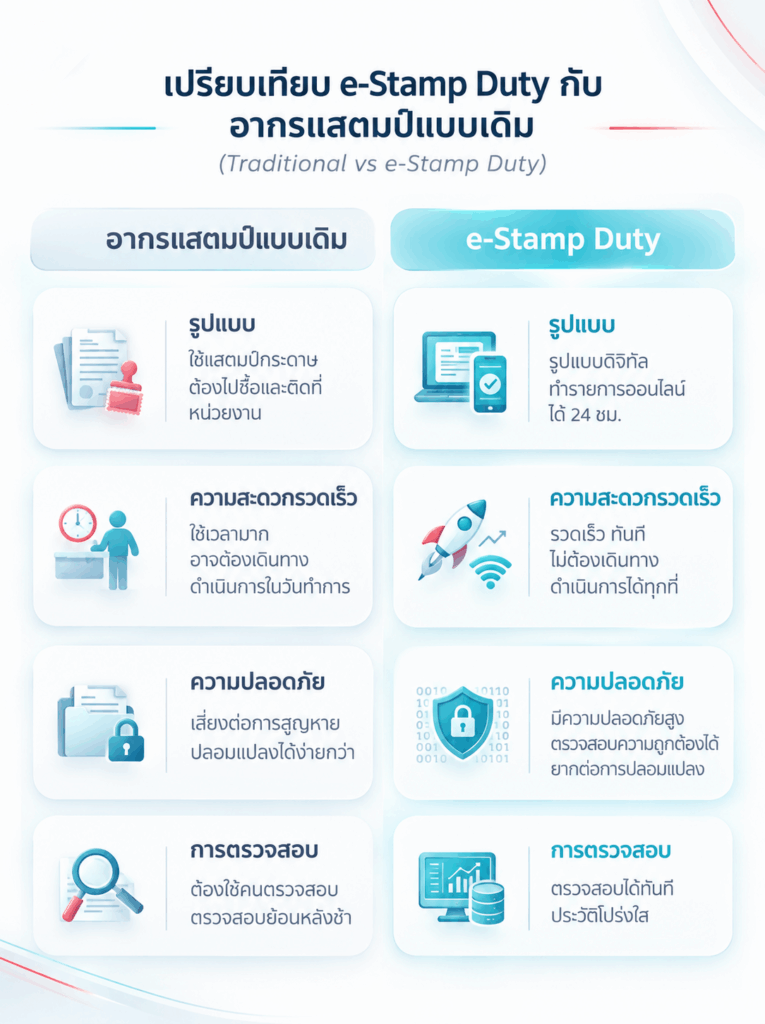
  • Automated e-Stamp Duty — An automated electronic stamp duty solution that reduces processing time, improves operational efficiency, and ensures important business documents are properly stamped in compliance with legal requirements.

When every step is managed on a single platform, organizations can reduce processing time and improve transparency in document tracking and verification.

5. Support Both Input and Output Tax Management in a Single System (Procure-to-Pay)

Businesses do more than just issue tax invoices—they also receive large volumes of e-Tax Invoices and e-Receipts from business partners every day. If these documents still need to be downloaded, stored, and entered manually, the process can be time-consuming and prone to human error.

A Procure-to-Pay system supports the automatic receipt of billing documents from business partners, helping reduce document errors.

  • Receive e-Tax Invoices or invoices directly from business partners for billing.
  • Validate document accuracy and perform 2-way matching with Purchase Orders and 3-way matching with Goods Receipts to reduce processing time and minimize errors.
  • Consolidate all documents in a single repository.
  • Integrate with ERP systems to create Accounts Payable (AP) entries.
  • Eliminate duplicate data entry that may lead to duplicate payments.
  • Automatically follow up on receipt collection from business partners after payment, helping ensure complete and accurate accounting and tax documentation.

This approach enables more efficient management of both input and output taxes.


Frequently Asked Questions About eTax Systems

What is the difference between eTax and an e-Tax Invoice?

eTax refers to the overall system used to manage electronic tax documents, while an e-Tax Invoice is an electronic tax invoice—one of the document types issued through an eTax system.

How should I choose an eTax provider?

Consider a provider’s ability to integrate with business partners and ERP systems, support increasing document volumes as your business grows, and offer industry-standard security and compliance.

What is an e-Receipt, and how does it relate to eTax?

An e-Receipt is an electronic receipt. A modern eTax system should support issuing both e-Receipts and e-Tax Invoices within a single platform.


Choose an eTax System That Supports Your Business Growth

Mr. Chayapat Assavavimolnan, Manager and Electronic Tax & Digital Document Solutions Expert at I AM Consulting, recommends that organizations should look beyond the basic capability of issuing e-Tax Invoices when selecting an eTax system. They should also consider the system’s ability to integrate with business applications, support growing transaction volumes, manage digital documents efficiently, and scale as the organization expands.

EZTax, developed by I AM Consulting, is designed to meet the needs of organizations of all sizes. It supports everything from e-Tax Invoice issuance and integration with ERP systems and Modern Trade partners to invoice management and Matching-to-Pay processes—all on a single platform. This enables organizations to streamline operations, improve data accuracy, and accelerate their digital transformation.

If you would like to learn more about implementing an eTax system in your organization, feel free to contact us.

Contact Us
📱 Phone+662-026-3964
📧 Emailinfo@iamconsulting.co.th
🌐 Websitewww.iamconsulting.co.th

AI Use Cases on SAP That Thai Businesses Are Actually Using

Many organizations have talked about AI for years. But ask “what are you actually using AI for?” and the answer usually ends at a chatbot or a nice-looking dashboard. The truth is that AI use cases on SAP that deliver real business results rarely start with a massive project or a huge budget they start by solving small, everyday problems, such as:

  • Why does the CFO have to wait 7 minutes for a report every morning?
  • Why does the accounting team have to manually type invoice data into SAP?
  • Why do suppliers deliver late with no advance warning?

This article walks through AI use cases on SAP designed by I AM Consulting to solve exactly those problems, covering three core areas of the business, each with a real-world scenario and measurable results.

Why AI on SAP — Not Generic AI?

The difference with AI on SAP is that it accesses real business data directly within SAP S/4HANA. No need to export data first, build extra integrations, or train a model from scratch. SAP Business AI is embedded directly into existing workflows, so users can start immediately without changing their core processes.

Pillar 1: Finance Management — CFOs Decide in 2 Minutes

Finance Management is a use case built for finance executives especially CFOs and Finance Directors who need real-time information to make decisions, rather than waiting for a weekly report.

Real-World Example: Real-Time Cash Flow Analysis

The CFO needs to review liquidity before approving an investment. The finance team has to pull data from multiple SAP modules and export it to Excel for analysis — taking an average of 7 minutes each time.

The CFO types a question in plain language into Joule, such as “Show this month’s cash position compared to last month.” The system pulls data from SAP S/4HANA in real time and returns results with insights within 2 minutes.

75%50%<2 minutes
Reduction in cash flow analysis effortReduction in financial reporting analysis timeTime per cash position check

Profitability Insights and EBITDA Simulation

(EBITDA: earnings before interest, tax, depreciation, and amortization a measure of core business profitability.) Beyond cash flow, AI Finance Management also instantly analyzes profitability by product line, customer segment, or region, and can run simulations such as “If raw material costs rise 15%, how much does that impact EBITDA?” giving CFOs more accurate forward planning.

Pillar 2: Zero Touch Accountant — An Accounting System That Barely Touches a Document

For accounting teams, the most time-consuming work is entering invoice data into the system, matching purchase orders, and fixing errors caused by manual entry. The Zero Touch Accountant concept uses AI on SAP to take over all of that work.

Real-World Example: Automated Invoice Reading with AI + OCR

The accounting team receives 50–200 supplier invoices by email every day. Each one must be opened individually, entered into SAP, checked against the purchase order and goods receipt, and then posted. This process consumes one full-time employee’s entire day.

Invoices are automatically routed into SAP. AI reads the data via OCR, matches it against the PO and GR, verifies accuracy, and posts the entry without any human touch. If something doesn’t match, the system flags it and alerts a staff member to review only the problematic items.

91%500 hours/month
Vendor invoices processed automaticallyTime saved through automation

GR/IR Reconciliation and Faster Period Close

GR/IR reconciliation the accounting team’s nightmare at month-end close is also aided by AI, which analyzes open balances, identifies why postings aren’t clearing, and recommends next steps for staff, instead of requiring line-by-line manual review. This significantly speeds up period close.

Pillar 3: Proactive Supply Chain — Spotting Problems Before They Happen

In supply chain management, most problems don’t appear out of nowhere they happen because no system is reading the warning signs. The Proactive Supply Chain AI use case on SAP shifts organizations from “reacting” to “predicting and preventing.”

Real-World Example: Forecasting Delivery Risk in Advance

The procurement team only learns a supplier is running late after the delivery date has already passed, forcing a scramble for a fix usually expensive and disruptive to the production line.

AI analyzes each supplier’s delivery history, production conditions, and external factors, then provides a 2–4 week advance warning on which POs are at risk of delay. This lets the team line up a backup supplier or adjust the production plan before the problem occurs.

PR Consolidation — Combining Purchase Requests for Greater Negotiating Power

Another AI use case with clear impact is consolidating purchase requests from multiple departments within SAP (PR Consolidation), allowing the procurement team to negotiate with suppliers as a large-volume buyer rather than purchasing piecemeal — reducing costs and shortening lead times.


“What matters isn’t just knowing what AI can do, but designing AI use cases that match the organization’s actual pain points. When AI solves the right problem, it delivers real business results.”

— Sasithorn Sitthikraisorn, I AM Consulting


These three pillars of AI adoption aren’t a future concept they’re capabilities organizations can use today on SAP ERP. The advantage is that organizations already running SAP don’t need to invest in new infrastructure; they simply need to activate the capabilities already embedded in SAP Business AI and design use cases that match their real pain points.

This is exactly what I AM Consulting specializes in. We don’t just demonstrate what AI can do — we help organizations design AI adoption that works in practice, becoming a real driving force behind business decisions and operations.

Get a free consultation with an SAP expert > I AM Consulting

SAP Retail AI 2026 Update: AI at the Core of Modern Retail

Some say AI is just a trend… but in 2026, AI has become the core force driving nearly every industry. One of the battlegrounds where this shift is most visible is retail. At NRF 2026, global giant SAP announced a major industry shake-up with its “SAP Retail AI” concept elevating AI from a mere add-on feature (point solution) into the full “core” of the entire retail operating system.

What Is SAP Retail AI, and Why Should Today’s Executives Pay Attention?

Retail businesses today face challenges far more complex than before: rapidly shifting consumer behavior, volatile demand, fragmented sales channels, and inventory that’s increasingly difficult to control.

SAP is changing the game by breaking down old silos connecting data, business processes, and AI end-to-end to create an AI-Enhanced Retail Operating System, an intelligent operating system that lets businesses see the big picture, analyze, and respond to the market in real time.

What’s changed is that AI no longer just “analyzes data and reports results.” It has evolved into Autonomous & Agentic AI capable of actually taking action and making decisions alongside humans from product planning and promotion management to closing sales on our behalf.

A Closer Look: 4 Game-Changing Innovations from SAP

1. Retail Intelligence: AI-Powered Stock Planning and Precise Demand Forecasting

An intelligent feature built on a next-generation data platform that pulls real-time data from every connected touchpoint (sales, inventory, customers, suppliers) into one place. AI then generates AI-Generated Simulations, helping planning teams forecast demand with precision, reduce redundant manual work, cut excess inventory costs, and boost competitiveness.

2. Order Reliability Agent: Smart AI That Watches Orders Before Problems Happen

This is an AI agent within the SAP Order Management Services package that acts as eyes and ears, monitoring orders in real time. If the system detects risk. Such as low stock, delays in fulfillment, or shipping issues AI immediately alerts the team, so customer service can step in and resolve issues or respond to customers quickly, before problems affect customer satisfaction.

3. AI-Assisted Assortment & Omnichannel Promotions: Manage Products and Promotions via Natural Language Commands

Executives and planners can issue commands through Joule Copilot using plain natural language, such as: “Help me create a beverage promotion for Gen Z customers for the end of this month.” AI calculates and recommends the right product assortment and promotions, connecting SAP Omnichannel Promotion Pricing with SAP S/4HANA Cloud Public Edition to sync promotions seamlessly across every channel in-store, website, marketplace, and mobile app.

4. Agentic Commerce: When AI Becomes the Brand’s New Storefront

This is the most closely watched highlight. SAP is driving the concept of Agentic Commerce through Storefront MCP Server technology on SAP Commerce Cloud opening the door for external AI assistants (such as ChatGPT or other intelligent assistant systems) to directly “understand” a brand’s product information, pricing, and stock.

This means customers no longer need to visit a website to search the old-fashioned way. Instead, they can simply ask their own AI: “Help me find running shoes under 3,000 baht that can be delivered today.” The AI then checks stock, looks for promotions, compares options, and takes the customer straight to checkout. In the future, “everywhere a customer talks to AI” can instantly become a brand’s new storefront.

Step Into the New Future of Retail with I AM Consulting

Today, the retail industry has crossed a major turning point. AI is no longer just a “nice-to-have” tool it has become the infrastructure that determines business survival.

The good news is that the transition to this intelligent system doesn’t have to wait for the future, because businesses can start building the foundation today. I AM Consulting, as an SAP Partner with the expertise and experience implementing systems for leading organizations in Thailand, is ready to walk alongside you in designing AI use cases that truly fit your retail business structure.

We believe that effective AI isn’t just AI with cutting-edge functions it must be AI that connects seamlessly with back-end systems and delivers real business outcomes.

Experience business driven transformation with SAP Retail AI, and get ahead in strategizing your journey to becoming an Autonomous Retail Enterprise.

Contact I AM Consulting

ช่องทางรายละเอียด
📱 Phone+662-026-3964
📧 Emailinfo@iamconsulting.co.th
🌐 Websitewww.iamconsulting.co.th

AI Starts with Trusted Data with SAP Business Data Cloud

SAP Datasphere helps organizations unify and manage data from multiple sources. When combined with SAP Analytics Cloud (SAC) for cloud-based analytics, planning, and forecasting, businesses can make faster, more accurate decisions. Today, these capabilities are delivered together as part of SAP Business Data Cloud, providing an end-to-end platform for enterprise data management and analytics.

Today, no organization can afford to ignore AI. It has become a key driver of business transformation, with companies expecting it to deliver powerful insights and greater operational efficiency. However, one critical factor is often overlooked: data quality.

The performance of AI depends entirely on the quality of the data it receives. Clean, trusted, and well-governed data enables AI to generate meaningful insights and reliable recommendations. This is where SAP Datasphere and SAP Analytics Cloud (SAC) play a vital role.

What Is SAP Datasphere?

SAP Datasphere is a comprehensive data management solution that enables data professionals to connect, access, manage, and leverage business data from multiple sources efficiently.

In today’s business environment, data is often scattered across different systems, whether on-premises or in the cloud. SAP Datasphere brings these disconnected data sources together into a unified environment while preserving business context and governance.

Built on the SAP Business Technology Platform (SAP BTP), SAP Datasphere is the next generation of SAP Data Warehouse Cloud. It provides enterprise-grade security, including database protection, encryption, governance, and compliance.

Key Capabilities of SAP DataSphere

  • Data Integration
  • Data Cataloging
  • Semantic Modeling
  • Data Warehousing
  • Data Virtualization

While organizing and governing enterprise data is essential, it is only the first step. To unlock real business value, organizations need to transform that data into actionable insights. This is where SAP Analytics Cloud comes in.

What Is SAP Analytics Cloud?

SAP Analytics Cloud (SAC) is an all-in-one cloud solution that combines advanced analytics, business intelligence (BI), planning, and predictive capabilities to help organizations maximize the value of their data investments.

What Makes SAP Analytics Cloud Different?

1. Trusted AI Integration

SAP Analytics Cloud incorporates Generative AI to automate reporting, uncover hidden insights, and support business planning through Joule Copilot.

Users can ask questions in natural language and instantly receive relevant answers, analytics, and recommendations making data exploration faster and more accessible for everyone.

2. Built-in Business Intelligence

Accelerate dashboard and report creation using pre-built Business Content, including:

  • Industry-specific KPIs
  • Business models
  • Data flows
  • Best-practice templates

These ready-to-use assets support a wide range of business functions, from finance and procurement to human resources.

3. End-to-End Advanced Analytics

SAP Analytics Cloud eliminates planning silos by bringing together:

  • Data preparation
  • Data modeling
  • Planning
  • Analytics

With seamless integration to SAP Datasphere, organizations can automatically generate insights and analyze large volumes of data with high performance and scalability.

Are You Ready to Improve Your Data Quality?

High-quality data is the foundation of successful AI initiatives and smarter business decisions.

By investing in a trusted data platform, organizations can transform raw data into meaningful business value enabling faster decisions, stronger forecasting, and sustainable competitive advantage.


Frequently Asked Questions (FAQ)

Q: Are SAP Datasphere and SAP Analytics Cloud still available?

A: Yes. Today, SAP delivers these capabilities through a unified solution called SAP Business Data Cloud, which brings together enterprise data management, analytics, and AI in a single platform.

Q: What is SAP Business Data Cloud?

A: SAP Business Data Cloud is a fully managed Software-as-a-Service (SaaS) solution that centralizes and governs enterprise data across SAP systems while seamlessly integrating third-party data sources.

It combines the powerful capabilities of SAP Datasphere and SAP Analytics Cloud, while also supporting integration with leading AI and data platforms such as Databricks and Snowflake. This enables organizations to harmonize enterprise data for advanced planning and analytics, including financial planning, workforce planning, and more.

Q: How is SAP Analytics Cloud different from other cloud analytics solutions?

A: SAP Analytics Cloud offers several unique advantages:

  • Combines analytics and planning in a single solution
  • Includes more than 100 pre-built best-practice business content packages across multiple industries
  • Uses advanced technologies to automatically generate insights and accelerate the development of custom analytics applications
  • Supports enterprise planning with seamless access to SAP business data, improving collaboration and planning efficiency across the organization

Q: Can SAP Analytics Cloud connect to external data sources?

A: Yes. Through SAP Datasphere, SAP Analytics Cloud can connect to both on-premises and cloud-based data sources, including SAP systems, SQL databases, OData services, Google BigQuery, consolidation systems, and many other third-party platforms.

Partner with I AM Consulting

I AM Consulting helps organizations establish a strong Data & Analytics foundation through end-to-end consulting services.

Our expertise covers:

  • Enterprise data architecture design
  • SAP and non-SAP system integration
  • Data platform implementation
  • AI and Analytics deployment
  • Business intelligence and enterprise planning

Because better business decisions begin with trusted data and trusted data starts with experts who understand both technology and business.

Contact I AM Consulting

Phone: +66 (0)2-026-3964

Email: info@iamconsulting.co.th

LINE Official: https://cutt.ly/iamline

What Is the SAP Business AI Platform? Next-Generation AI Platform

AI is rapidly becoming the driving force behind modern business. However, business data is often scattered across multiple systems, workflows are complex, and organizations must continuously ensure data security, governance, and accuracy. These challenges are exactly why the SAP Business AI Platform was developed—to take enterprise AI to the next level.

What Is the SAP Business AI Platform?

The SAP Business AI Platform is SAP’s next-generation AI platform that brings together the capabilities of SAP Business Technology Platform (SAP BTP), SAP Business Data Cloud, and SAP Business AI into a single, unified platform. It enables organizations to build, integrate, extend, and govern AI across the enterprise with a comprehensive end-to-end approach.

Rather than simply providing tools to build AI, the SAP Business AI Platform is designed to help organizations create AI systems that understand business context, work with trusted business data, and securely connect across both SAP and non-SAP applications. This enables AI to deliver more accurate, relevant, and business-ready insights while maintaining enterprise-grade security, governance, and compliance.

Why Do Organizations Need an AI Platform for Business?

While many organizations have started adopting Generative AI, they often encounter critical challenges that limit its business value:

  • AI lacks an understanding of internal business data and processes.
  • Business data is fragmented across multiple systems, making integration difficult.
  • Security, governance, and compliance are difficult to enforce consistently.
  • AI-generated responses often lack transparency, making them difficult to verify or trace back to trusted sources.

Business AI Platform addresses these challenges by enabling AI to access trusted business data, understand business context, and operate within the organization’s security, governance, and compliance frameworks. As a result, organizations can deploy AI that is not only more intelligent and accurate, but also secure, transparent, and ready for enterprise-wide use.

The Three Pillars of the SAP Business AI Platform

1. Build

SAP Business Technology Platform (SAP BTP) provides a unified development environment where developers and business users can build AI agents, automate workflows, and create business applications—all within a single platform.

At the core is Joule Studio, an AI-first development environment that supports low-code, no-code, and pro-code development. Integrated with SAP Integration Suite, it enables AI to seamlessly connect and orchestrate processes across both SAP and non-SAP systems, accelerating enterprise AI adoption while simplifying development.

2. Contextualize & Reason

What sets the Business AI Platform apart from general-purpose AI is its ability to understand business context.

Powered by SAP Business Data Cloud, the platform unifies trusted data from across the enterprise while preserving the relationships between customers, suppliers, business processes, and organizational rules. By providing AI with rich business context rather than isolated data, it enables more accurate insights, better decision-making, and more reliable business outcomes.

3. Govern

Successful enterprise AI requires more than powerful models—it demands strong governance. The SAP Business AI Platform provides comprehensive tools to manage AI agents throughout their entire lifecycle, from access control and policy enforcement to security, API management, and performance monitoring. This ensures that every AI application operates securely, transparently, and in compliance with organizational standards and governance requirements.

Use Case

The SAP Business AI Platform can be applied across a wide range of business scenarios, including:

  • Building AI agents to support finance, procurement, and other business functions by answering questions and assisting with routine tasks.
  • Analyzing sales data in real time to generate actionable insights and support faster decision-making.
  • Automating workflows across SAP and non-SAP systems to streamline end-to-end business processes.
  • Forecasting demand and optimizing supply chain planning using AI-driven predictive analytics.
  • Developing AI-powered business applications that enhance employee productivity with intelligent assistance embedded into daily workflows.

Who Should Use the SAP Business AI Platform?

The SAP Business AI Platform is designed for organizations looking to adopt AI at an enterprise scale. It is particularly well suited for businesses that manage large volumes of data, operate across both SAP and non-SAP systems, or want to build AI agents that can securely integrate with real business processes while meeting enterprise security, governance, and compliance requirements.

Conclusion

The SAP Business AI Platform is an enterprise AI platform that brings together AI development, trusted business data, business context, and governance in a single platform. It enables organizations to build AI agents and intelligent business applications powered by real business data, securely connecting both SAP and non-SAP systems. With enterprise-grade security, scalability, and governance, it provides a strong foundation for organizations on their journey toward becoming an Autonomous Enterprise.

Source: SAP

The 3R Framework for AI Investment Decisions

Organizations across Thailand are spending heavily on AI—from chatbots and automation tools to AI copilots. Yet many initiatives never move beyond proof of concept or pilot projects, failing to scale across the enterprise.

Without enterprise-wide adoption and measurable business outcomes, organizations inevitably start asking the same question: Was our AI investment really worth it?

Mr. Boonthor Suriyabuncherd, Deputy Managing Director of I AM Consulting Co., Ltd., shared that successful AI adoption requires more than implementing new technologies. Organizations should evaluate their AI initiatives through an AI Adoption Framework, also known as the 3R Framework, which consists of:

1. Relevance – Ensure AI initiatives create measurable value that aligns with your organization’s strategic business objectives.

AI initiatives should clearly demonstrate how they will create tangible business value. Whether the goal is to improve operational efficiency, enhance customer experiences, or reduce operating costs, the expected outcomes should be measurable and aligned with the organization’s strategic objectives.

2. Reliable – Build AI on accurate, trusted, and high-quality data.

The effectiveness of AI depends on the quality of the data it is built upon. Organizations should ensure that the data used for analysis and decision-making is accurate, reliable, and representative of their business context. Whether it is sales data, demand forecasts, or operational data, trusted data enables AI to generate more accurate insights and recommendations that can be confidently applied to real-world business decisions.

3. Responsible – Adopt AI responsibly with strong governance, transparency, and ethical principles.

Responsible AI adoption requires strong data governance, security, and risk management. Organizations must ensure that sensitive data is protected and handled in compliance with privacy regulations, cybersecurity standards, and applicable legal requirements. Establishing clear AI governance policies and ethical guidelines helps ensure that AI is deployed transparently, responsibly, and in accordance with corporate compliance standards.

AI for Enterprise Software

As a leading SAP implementation and digital transformation partner, I AM Consulting believes that the future of Enterprise AI extends far beyond being a productivity tool. AI should empower organizations to transform their operations and progress toward becoming a truly Autonomous Enterprise—where intelligent systems can automate processes, support data-driven decision-making, and continuously optimize business operations with minimal human intervention.

Most recently, SAP introduced Joule, its AI copilot for the enterprise, designed to operate within real business contexts. By connecting enterprise data, business processes, and applications across the organization, Joule enables employees to make faster, more informed decisions while driving intelligent automation at scale. This allows organizations to improve productivity, streamline operations, and accelerate their journey toward an Autonomous Enterprise.

Joule stands apart from conventional AI assistants in the market with several key differentiators, including:

1. Deep Understanding of Business Context Through SAP Data

Unlike general-purpose AI, Joule operates on your organization’s existing SAP business context rather than publicly available data. By leveraging trusted enterprise data, it delivers more accurate, context-aware recommendations and intelligent automation tailored to your business. Enterprise data remains under your organization’s control and is not used to train external large language models (LLMs), helping ensure security, privacy, and compliance.

2. Works Seamlessly Across SAP and Non-SAP Systems

Joule connects business processes across Finance, Supply Chain, Human Resources, Procurement, and Operations, while extending beyond the SAP ecosystem. Through integrations with Microsoft 365 Copilot, the Agent2Agent (A2A) Protocol, and Model Context Protocol (MCP) servers, Joule enables seamless collaboration across SAP and non-SAP applications. This allows AI to orchestrate end-to-end business processes without being confined to a single platform or technology stack.

3. Scale with Confidence Through Built-in Governance

Joule leverages existing SAP access controls and authorization models to protect enterprise data, eliminating the need to rebuild permissions from scratch. This allows IT teams to scale AI adoption across departments more efficiently while maintaining robust security, governance, and compliance. With built-in auditability and policy enforcement, organizations can confidently expand AI within a trusted and controlled environment.


How Does Joule Empower Every Business Function?

Joule offers more than 2,100 AI skills designed to support the day-to-day work of every business function. According to SAP Discovery Center, organizations can realize measurable productivity gains across the enterprise, including:

DepartmentJoule Use CaseBusiness Impact
FinanceAccounts Receivable ReconciliationReduce processing time by up to 75%
Supply ChainImport/Export Product ClassificationReduce processing time by up to 50%
ProcurementRFP Document GenerationReduce processing time by up to 70%
HREmployee Performance Review PreparationReduce processing time by up to 70%
Sales & MarketingAI Shopping AgentIncrease Average Order Value (AOV) by 5%
OperationsField Service DispatcherIncrease productivity by up to 50%

Overall, routine day-to-day tasks can be completed up to 90% faster, while productivity for complex end-to-end business processes can increase by up to 75%, according to SAP.


The Road to Scalable Enterprise AI Investment

SAP defines a three-step journey to unlock the full value of Joule:

Step 1 – Supercharge Human Performance

Embed AI into employees’ daily workflows without disrupting existing business processes. Teams continue working within their familiar SAP applications while Joule provides real-time insights, recommends the next best actions, and supports faster, more informed decision-making based on live business data.

Step 2 – Break Down Silos

Joule’s AI agents collaborate seamlessly across business functions, connecting Finance, Procurement, Human Resources, Supply Chain, and other departments. By sharing business context and coordinating workflows across teams, Joule eliminates information silos, reduces handoff delays, and ensures that critical data flows smoothly throughout the organization.

Step 3 – Scale with Agility

Rapidly scale AI across the enterprise by building on SAP’s existing security, governance, and compliance framework. By leveraging established access controls and enterprise policies, organizations can accelerate AI deployment while minimizing complexity, reducing risk, and maintaining a secure, well-governed environment.


Successful AI adoption is not driven by technology alone. It requires a deep understanding of business processes, trusted enterprise data, and effective organizational change management. Organizations that align these three elements are far more likely to realize measurable business value and achieve AI adoption at scale.

At I AM Consulting, we combine deep SAP expertise with extensive experience in enterprise transformation to help organizations build a strong foundation for AI adoption. From defining an AI strategy and identifying high-value use cases to implementation, governance, and enterprise-wide scaling, we partner with our customers at every stage of their journey toward becoming an Autonomous Enterprise.

Contact Us
📱 Phone+662-026-3964
📧 Emailinfo@iamconsulting.co.th
🌐 Websitewww.iamconsulting.co.th
Privacy Overview

This website uses cookies so that we can provide you with the best user experience possible. Cookie information is stored in your browser and performs functions such as recognising you when you return to our website and helping our team to understand which sections of the website you find most interesting and useful.