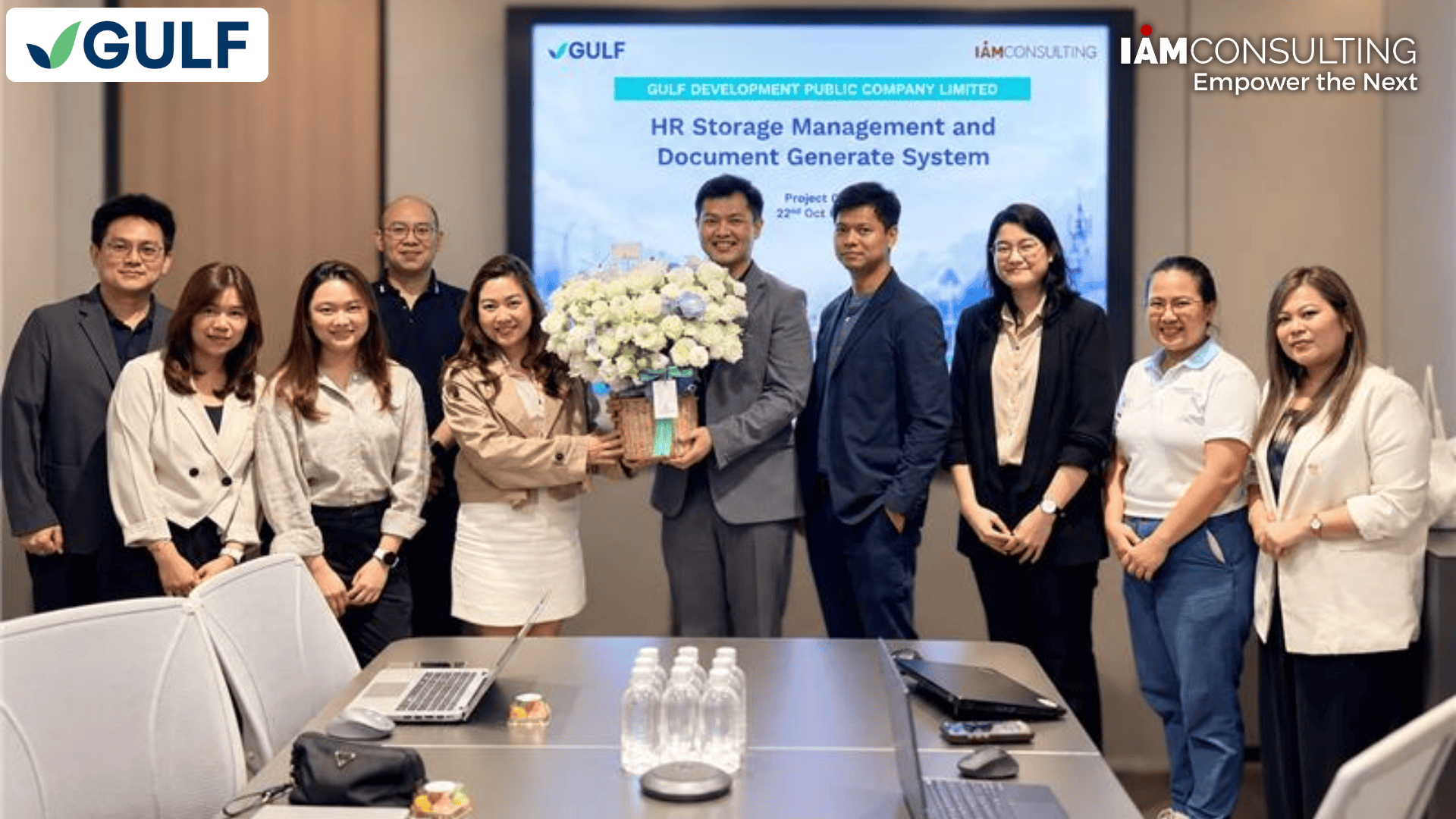
GULF – HR Storage Management System Project Go-Live

Another significant milestone for GULF in its digital transformation journey, integrating iZign, a Digital Signature platform, with SAP SuccessFactors, a world-leading HR solution.

.

This integration streamlines HR document management, reduces repetitive tasks, and enhances data accuracy and security. It reflects GULF’s commitment as one of Thailand’s leading energy and infrastructure groups to continuously advancing its operations through digital innovation.

.

This achievement also highlights the strong, long-standing partnership and mutual trust between GULF and I AM Consulting.

.

We sincerely thank GULF for its continued trust and confidence in us. We are proud to be part of this transformation journey and look forward to working alongside GULF to unlock new opportunities for the future.

.

Contact I AM Consulting

☎️ Tel: 02-026-3964

💌 E-mail: info@iamconsulting.co.th

💚 LINE@: https://cutt.ly/iamline

.

hashtag#IAMConsulting hashtag#GULF hashtag#iZign hashtag#HRTransformation hashtag#DigitalHR hashtag#SAPSuccessFactors hashtag#Empowerthenext hashtag#WhenIAMpromisesIAMdelivers

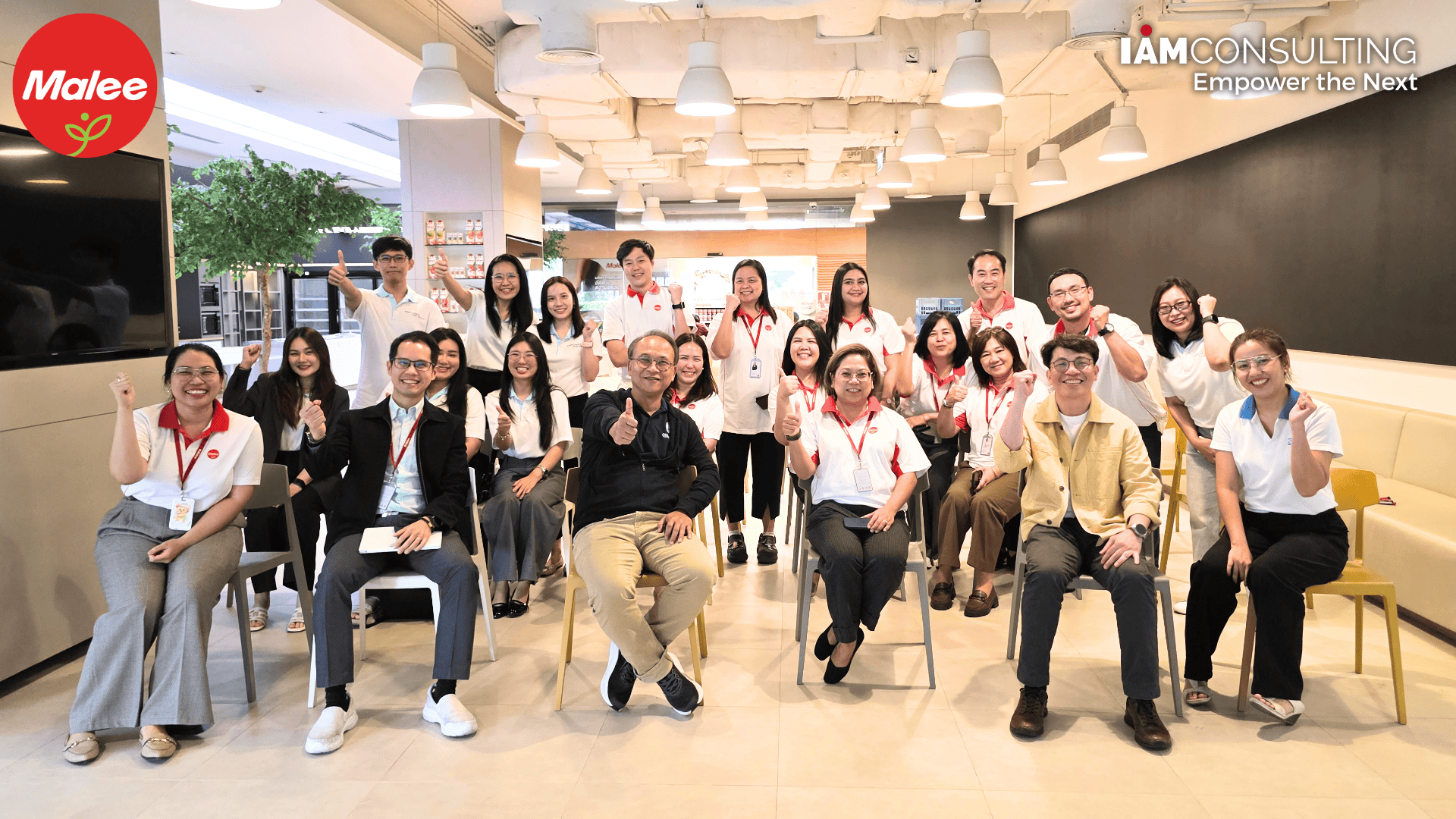
Malee Group – SAP SuccessFactors Go-Live

Congratulations to Malee Group on another significant milestone in its HR transformation journey with the successful Go-Live of SAP SuccessFactors. This marks an important step in empowering HR to become a strategic driver of business growth, supporting Malee Group’s ambition to become the “Top Beverage of Choice.”

While its existing systems continued to meet business needs, Malee Group chose to take a step further, preparing its people for the future in the digital era. Guided by the belief that “A strong future begins with a solid foundation from within,” this transformation goes beyond simply implementing a new system. It is about redefining how the organization supports and empowers its people, simplifying processes, enhancing agility, and enabling HR to focus on what matters most: “Unlocking the full potential of its people.”

This milestone also reflects the strength of a long-term partnership spanning over 10 years between Malee Group and I AM Consulting. Together, we have navigated change, embraced new opportunities, and grown through mutual trust, deep business understanding, and strong collaboration.

We sincerely thank Malee Group for its continued trust throughout this journey. We are proud to be part of this achievement and remain committed to building a stronger foundation together, empowering the organization to achieve sustainable growth for years to come.

.

.

Contact I AM Consulting

☎️ 02-026-3964

✉️ E-mail : info@iamconsulting.co.th

💚 LINE@ : https://cutt.ly/iamline

.

hashtag#IAMConsulting hashtag#HR

hashtag#HRTransformation

hashtag#SAP hashtag#SuccessFactors

hashtag#Empowerthenext hashtag#Malee

hashtag#WhenIAMpromisesIAMdelivers

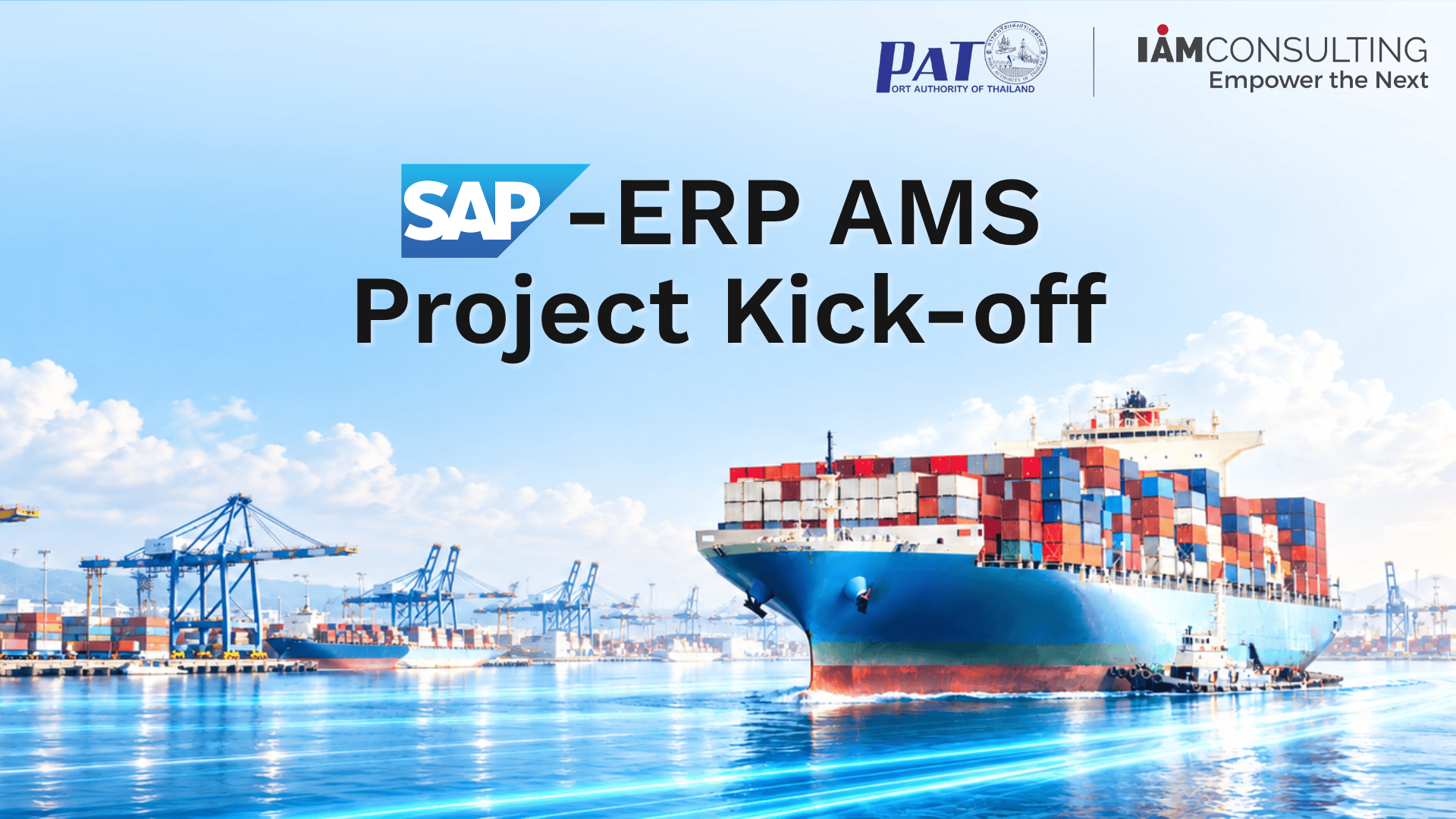
Port Authority of Thailand – SAP-ERP AMS Project Kickoff

The Port Authority of Thailand (PAT), a key organization driving Thailand’s logistics sector and national economy, continues to enhance its operational efficiency by entrusting I AM Consulting with the maintenance and support of its Financial Accounting, Management Accounting, and Enterprise Resource Planning (ERP) systems.

.

Behind every successful organization lies a strong, reliable, and resilient technology foundation that supports seamless daily operations. This Project Kickoff marks an important milestone in aligning both teams, establishing a shared understanding, and defining a collaborative approach to ensure smooth system operations that meet PAT’s business needs.

.

With our extensive experience and expertise, I AM Consulting is committed to ensuring optimal system performance and operational continuity. We are proud to support the Port Authority of Thailand in strengthening its digital capabilities and driving sustainable digital transformation.

.

.

Contact I AM Consulting

☎️ Tel: 02-026-3964
💌 E-mail: info@iamconsulting.co.th
💚 LINE@: https://cutt.ly/iamline

.

#IAMConsulting #PAT #PortAuthorityofThailand #SAP #AMS #Kickoff #ERP #EmpowerTheNext #WhenIAMpromisesIAMdelivers

Introducing the New Joule Studio: More Than Just an AI Coding Assistant

As AI evolves beyond simply answering questions to planning, making decisions, coordinating tasks, and executing business processes, organizations have new opportunities to accelerate their digital transformation.

Meet SAP Joule Studio, an AI development environment designed to support an AI-first approach, enabling organizations to build intelligent solutions that understand business context and integrate with enterprise systems and workflows.

What Is Joule Studio?

Joule Studio is SAP’s AI development environment designed to help organizations build AI solutions tailored to their specific business processes and requirements.

What sets Joule Studio apart is its focus on more than simply creating AI. It brings together business context, enterprise data, processes, and systems to help developers build AI solutions that are better aligned with real-world business operations.

Joule Studio also supports both Low-Code and Pro-Code development, allowing organizations to choose the most suitable development approach based on project requirements and team capabilities.

What Can Joule Studio Do?

Joule Studio brings together four key capabilities for building enterprise AI solutions: AI Agents, Applications, Workflows, and Managed Runtime.

1. AI Agents: Build AI Agents Tailored to Business Needs

Joule Studio enables organizations to build and deploy AI agents designed around their unique business context and operational processes.

These AI agents can support task execution and decision-making, helping organizations automate activities and enhance decision support across business operations.

Another key capability is interoperability through standards such as Model Context Protocol (MCP) and Agent2Agent (A2A). These standards enable AI agents to connect with enterprise systems, collaborate with other agents, and interact across SAP and non-SAP environments.

For enterprise governance, Joule Studio also provides capabilities to manage agent access, performance, observability, and lifecycle management. These are essential considerations when deploying AI across business-critical operations.

2. Applications: Accelerate Application Development from Idea to Deployment

Joule Studio helps accelerate application development with AI, supporting the journey from prompt-based ideation to deployment.

Developers can use Joule Studio to create full-stack applications, including user interfaces, business logic, and backend services.

Another important capability is extending SAP solutions, particularly by developing AI-powered applications for SAP S/4HANA. This allows organizations to enhance existing business systems while maintaining a Clean Core Strategy.

For development teams, Joule Studio can also work alongside existing tools, frameworks, and development environments. This enables organizations to incorporate AI into their development processes without necessarily replacing their established technology stack.

3. Workflows: Integrate AI into End-to-End Business Processes

Another important capability of Joule Studio is enabling organizations to create and manage workflows that connect AI agents with enterprise systems and business processes.

Organizations can build multi-agent workflows, allowing multiple AI agents to collaborate, plan activities, and execute tasks according to defined processes.

AI agents can also be embedded into end-to-end business workflows, making AI an integrated part of daily operations rather than a standalone tool.

For more complex workflows, visual and Low-Code development approaches help simplify workflow design and accelerate implementation.

4. Managed Runtime: Deploy and Manage AI in a Managed Environment

Building AI solutions is only part of the challenge. Organizations must also deploy, operate, and manage these solutions reliably in production environments.

Joule Studio addresses this need through Managed Runtime, enabling teams to deploy solutions directly from the development environment without having to manage the underlying infrastructure themselves.

This managed environment is designed to work with the SAP agent ecosystem and support business-critical workloads, with enterprise-level security, compliance, and governance capabilities.

How Can Joule Studio Benefit Organizations?

Adopting AI in the enterprise involves more than developing intelligent applications. Organizations must ensure that AI can securely connect with existing data, systems, and processes while remaining manageable and governed.

Joule Studio helps address these requirements through several key benefits.

Accelerate the Journey from Idea to Production

Joule Studio incorporates AI into the development lifecycle, from application creation to deployment. This can help streamline development activities, reduce manual effort, and shorten the time required to bring AI solutions into production.

Build AI Solutions Grounded in Business Context

Organizations can incorporate their own business data, processes, and context into AI development.

This enables teams to design AI solutions that better reflect actual business requirements and operational workflows.

Connect SAP and Non-SAP Systems

Joule Studio supports integration across SAP and third-party environments through connectivity approaches and standards such as MCP and A2A.

This allows organizations to develop AI solutions that work within their existing enterprise technology landscape.

Support Both Low-Code and Pro-Code Development

Different projects require different development approaches.

Joule Studio allows organizations to choose between Low-Code workflow development and Pro-Code approaches for building more advanced applications and AI solutions, depending on technical requirements and team expertise.

Strengthen Enterprise AI Governance

As AI becomes more deeply integrated into business-critical operations, security, identity management, monitoring, and compliance become increasingly important.

Joule Studio provides capabilities covering identity and access control, testing, validation, performance evaluation, observability, and lifecycle management.

These capabilities help organizations monitor, manage, and govern AI solutions throughout their operational lifecycle.

Who Is Joule Studio Designed For?

Joule Studio is designed for developers, solution architects, and technically skilled business teams looking to build enterprise AI solutions and extensions that integrate with SAP and third-party systems.

It is particularly relevant for organizations with IT and development teams seeking to:

  • Build AI agents for specific business processes.
  • Develop AI-powered applications and full-stack applications.
  • Create workflows that connect AI agents with enterprise systems.
  • Extend SAP solutions while following Clean Core principles.
  • Integrate AI with SAP and non-SAP systems.
  • Deploy and manage AI solutions without managing the underlying infrastructure.
  • Maintain enterprise-level security, governance, and AI lifecycle management.

Joule Studio and the Future of Enterprise AI

Enterprise AI development is moving beyond systems that simply respond to questions toward Agentic AI, where intelligent agents can understand business context, plan activities, and execute tasks within defined business processes.

Joule Studio represents SAP’s approach to this evolution by bringing together AI agents, application development, workflows, business context, and managed runtime within a unified development environment.

This enables IT teams and developers to build AI solutions that are more closely connected to real enterprise systems and operational requirements.

For organizations exploring the adoption of Enterprise AI, Joule Studio offers more than AI development capabilities. It provides an environment that supports the broader AI lifecycle, from development and integration to deployment, governance, and production management.

By connecting AI innovation with enterprise business processes, Joule Studio can help organizations move toward more intelligent, connected, and AI-driven operations.

Source: SAP Joule Studio


เตรียมองค์กรให้พร้อมสู่อนาคต

I AM Consulting ทีมที่ปรึกษา Digital Transformation ชั้นนำของไทย ผู้เชี่ยวชาญด้านธุรกิจ เทคโนโลยี และนวัตกรรม ที่พร้อมช่วยขับเคลื่อนองค์กรของคุณสู่การเติบโตในยุค AI

ช่องทางรายละเอียด
📱 Phone+662-026-3964
📧 Emailinfo@iamconsulting.co.th
🌐 Websitewww.iamconsulting.co.th

AssetWise – RISE with SAP S/4HANA Upgrade 2025 Kickoff

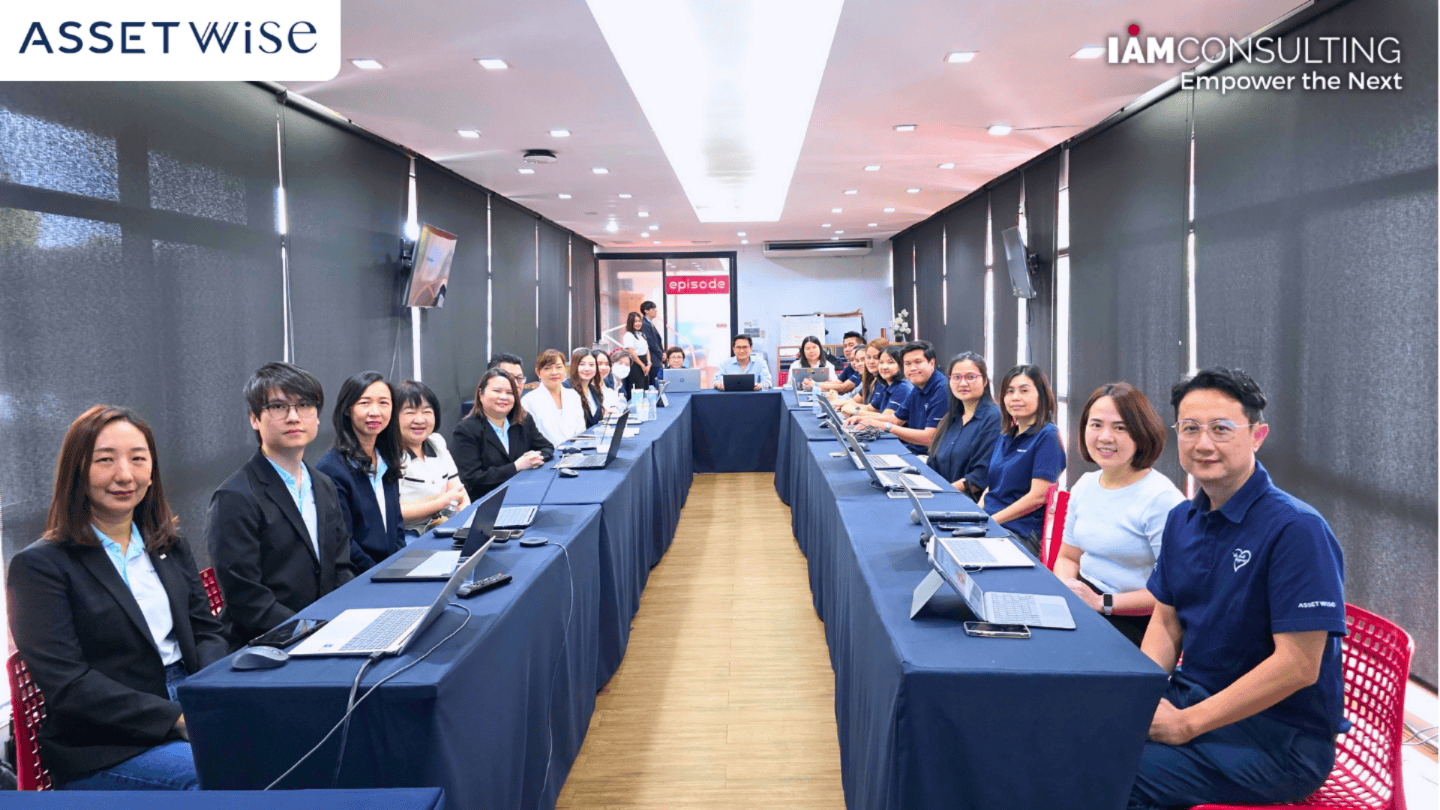
AssetWise, a leading real estate developer and recipient of the “Most Popular Developer in Thailand 2025” award, continues to reinforce its commitment to continuous development by upgrading RISE with SAP S/4HANA from Version 2021 to 2025. This milestone ensures a modern and future-ready management foundation, empowering the organization to move forward with Data, AI, and Automation.

More than just a version upgrade, this project is about preparing AssetWise for future growth and an increasingly diverse business portfolio. It also lays the foundation for adopting SAP innovations, including AI, OCR, Integration Suite, and SAP Business Data Cloud (BDC), enabling more connected, faster, and increasingly automated processes with I AM Consulting supporting AssetWise throughout every step of the journey.

Behind AssetWise’s commitment to “We Build Happiness” and delivering a better quality of life is a strong, reliable, and continuously evolving operational foundation. The move to RISE with SAP S/4HANA 2025 marks another important step toward sustainable growth, empowering AssetWise to continue creating better living experiences for its customers and society.

Autonomous Supply Chain How AI Turns Data into Decisions

Volatility is one of the biggest challenges facing today’s supply chains. From inflation and labor shortages to geopolitical tensions and unpredictable transportation delays, businesses are facing disruptions that can quickly impact operations. As a result, traditional Supply Chain Management models that still rely heavily on manual processes are no longer enough to keep pace with rapidly changing business environments.

In our previous article, we explored Autonomous Finance, an emerging AI trend that is transforming the finance function. This time, I AM Consulting takes a closer look at another critical area Autonomous Supply Chain.

Autonomous Supply Chain is transforming the way organizations manage operations and execute business strategies by enabling them to sense, predict, decide, and respond to changes faster and more accurately.

What Is an Autonomous Supply Chain?

Autonomous Supply Chain is an approach to Supply Chain Management that brings together AI, Business Data, Applications, and Automation to connect processes across the entire supply chain from Planning, Procurement, and Manufacturing to Logistics and Asset Management.

Instead of operating as separate functions, these processes can work together more intelligently, enabling the supply chain to analyze information, support decision-making, and adapt to changing conditions with greater levels of automation.

The key is not simply Automation, but Orchestration connecting People + Processes + Technology so they can operate as an integrated system.

By reducing Data Silos and creating End-to-End Supply Chain Visibility, organizations can respond to changes faster and make better-informed decisions.

Rather than requiring people to manually coordinate every step, an Autonomous Supply Chain enables Supply Chain Orchestration from upstream to downstream, helping businesses respond to disruptions and changing market conditions in a more timely and effective way.

4 Key Capabilities of an Autonomous Supply Chain

1. Greater Agility and Faster Decision-Making

An AI-driven Supply Chain can continuously adapt to changing conditions, connect operations across different functions, and help organizations deliver products and services with greater confidence.

By using AI to analyze data and identify potential issues, businesses can accelerate decision-making while improving their ability to respond to supply and demand fluctuations.

2. More Automated and Reliable Supply Chain Operations

By combining AI, Business Data, and Applications, organizations can orchestrate workflows and increase Supply Chain Automation.

This enables more decision-making processes to be automated, reducing the amount of manual work required to coordinate operations while improving consistency and operational efficiency.

3. End-to-End Supply Chain Visibility

Strong Supply Chain Visibility gives organizations a clearer view of what is happening across the entire supply chain. by connecting information across internal functions and external partners, businesses can reduce Operational Silos, improve data transparency, and gain an End-to-End, Real-Time view of supply chain operations.

This visibility provides decision-makers with the context they need to identify risks, understand their potential impact, and take action before disruptions escalate.

4. Faster and More Accurate Adaptation

An Autonomous Supply Chain helps organizations prepare for Supply Chain Disruptions and changes in customer demand through AI-driven recommendations and automated process adjustments.

As a result, organizations can respond to changes faster and more accurately while maintaining greater control over operations. This improves both Supply Chain Agility and overall Business Continuity.

How AI Agents Are Changing Supply Chain Management

One of the most important technologies behind the Autonomous Supply Chain is Agentic AI and the use of AI Agents. Unlike traditional AI systems that primarily provide answers or insights, an AI Agent can receive an Objective or Task, understand its context, coordinate with other systems, and execute parts of a workflow to achieve a specific goal.

SAP is applying this concept through Joule Agents and Joule Assistants across different areas of Supply Chain Management, helping transform previously disconnected data and processes into more Connected Workflows.

1. Planning Assistant

Working with SAP IBP (Integrated Business Planning), Planning Assistants can support Demand Sensing and Supply Optimization.

They can help Planners create, adjust, and review plans more quickly and accurately, while leveraging Predictive Insights and coordinating AI Agents to support planning and data-driven decision-making.

2. Logistics Assistant

Working with SAP TM (Transportation Management) and SAP EWM (Extended Warehouse Management), Logistics Assistants can help coordinate activities across Transportation, Warehousing, and Fulfillment in real time.

This enables teams to monitor changing logistics conditions and respond more quickly to transportation or fulfillment issues.

3. Manufacturing Assistant

Within SAP Digital Manufacturing (DM) or SAP S/4HANA Manufacturing, AI can help identify potential disruptions and assess their impact on Materials, Inventory, Quality, and Workforce.

The system can then recommend a Next Best Action, helping teams improve production efficiency through AI-supported decision-making and execution.

4. Product Design Assistant

Working with solutions across SAP PLM (Product Lifecycle Management) and SAP S/4HANA (R&D / Engineering), Product Design Assistants can help reduce the time from product concept to production.

By coordinating AI Agents to automate selected design-related activities, organizations can accelerate product development and improve decision-making throughout the product lifecycle.

5. Asset Operations Assistant

Working with SAP APM (Asset Performance Management), Asset Operations Assistants can coordinate AI Agents across Reliability, Maintenance Planning, Scheduling, and Execution.

Asset data and operational signals can be used to prioritize maintenance activities, allocate resources, and feed execution results back into the process for continuous improvement of asset performance.

Together, these examples demonstrate that an Autonomous Supply Chain is not created by AI or Automation alone.

It is built by connecting AI, Data, People, and Business Processes so that the supply chain can sense what is happening, coordinate activities, support decision-making, and respond to changes more quickly.

3 Business Outcomes of an Autonomous Supply Chain

Connecting systems, data, and processes across the supply chain can generate measurable business outcomes across areas such as Visibility, Efficiency, Inventory Management, and Operational Performance.

1. Up to 4x Greater Data Visibility

Connecting data and systems can provide organizations with a more comprehensive view of supply chain conditions, enabling teams to understand what is happening and make decisions faster.

2. Up to 80% Less Time Spent on Supply Chain Operations

Automating repetitive processes and reducing manual coordination can help organizations minimize operational workloads and improve process efficiency.

3. Up to 30% Reduction in Days Inventory Outstanding

Improved visibility and smarter decision-making can help organizations optimize Inventory Management and use working capital tied up in inventory more efficiently.

Autonomous Supply Chain in Action: Connecting Systems to Respond to Disruption

A sudden storm causes a vessel carrying a critical shipment of imported raw materials to be delayed by five days. Under a traditional supply chain model, the Procurement team may only become aware of the delay after receiving an update from the logistics provider. By the time the information reaches the factory and production teams, the disruption could already affect the production schedule. With an Autonomous Supply Chain, the response can happen much earlier.

1. Detect the Risk Immediately

The Logistics Assistant detects the vessel delay and analyzes it against current inventory levels. The system identifies that the delay could affect the production schedule for the following week.

2. Automatically Identify an Alternative

The system sends the signal to the Manufacturing Assistant, which identifies alternative production orders that have the required materials already available. The production schedule can then be adjusted to prioritize those orders.

3. Keep People in Control

The system prepares the recommended Next Best Action and presents the alternative plan to the Planner for review and approval.

Instead of spending hours making phone calls, checking spreadsheets, and organizing urgent cross-functional meetings, the Planner can review the recommendation and approve the action with minimal manual effort.

Production can continue with minimal disruption, helping the organization move toward Zero Downtime while reducing the time required for cross-functional coordination.

An Autonomous Supply Chain creates value beyond AI and Automation. It helps organizations improve Supply Chain Visibility, reduce operational workloads, optimize Inventory Management, and accelerate decision-making all of which are critical to building long-term Supply Chain Resilience and gaining a sustainable Competitive Advantage.

Our experts help businesses strengthen their capabilities across Data, Business Applications, AI, and Digital Transformation, enabling more agile, connected, and intelligent operations.

Build a smarter, more resilient Autonomous Supply Chain and prepare your organization for the future with I AM Consulting.

Autonomous HCM AI That Goes Beyond Traditional HR

As AI becomes increasingly embedded across every part of the organization, including Human Resources (HR), which works directly with people, the question is no longer whether AI will replace humans, but rather how we can use AI to help people become more capable and grow alongside the organization.

Previously, AI primarily helped answer questions, screen candidates, or summarize reports. Today, SAP is taking HR a step further with Autonomous HCM , transforming AI from a task-supporting tool into an intelligent assistant capable of analyzing data and supporting more complex people-related decisions.

In our previous articles, we explored the concept of the Autonomous Enterprise and one of its key components, Autonomous Finance. This time, I AM Consulting takes a closer look at another critical element of an organization.

Through the concept of Autonomous HCM, technology is transforming Human Resources from a function that relies heavily on manual processes into a more automated, data-driven function that can analyze information and support HR decision-making more effectively.

What Is Autonomous HCM?

Autonomous HCM, or Autonomous Human Capital Management, is an approach to human capital management that combines AI, Machine Learning, and Automation with end-to-end HR processes.

Its goal is to reduce repetitive work, analyze relevant information, and coordinate activities across different stages of HR processes so that they can operate more continuously and efficiently, while maintaining clear governance and keeping humans in control of critical decisions.

AI in Autonomous HCM therefore goes beyond simply answering questions like a chatbot. It can gather relevant information, determine which tools or resources are appropriate, and help execute processes involving multiple steps.

Autonomous HCM also connects employee data, skills, and business needs, allowing organizations to identify workforce trends, personalize learning and career development, and make it easier to operate in accordance with relevant policies and requirements.

The 3 Key Pillars of Autonomous HCM

SAP’s built around three key elements that connect people, data, and HR processes.

1. Powerful Agentic Experiences: AI That Understands Context and Handles Multi-Step Tasks

AI for HR is no longer limited to answering questions like a traditional chatbot. It can understand what users are trying to accomplish, gather relevant information, and coordinate multiple steps to move a process forward.

Tasks that previously required employees to search for information or switch between multiple systems can therefore be completed more efficiently.

This helps reduce administrative workloads and gives HR teams more time to focus on strategic priorities such as Workforce Strategy, Talent Development, and Employee Experience.

2. Trusted People Data: Effective AI Starts with Reliable People Data

The quality of AI-driven analysis and recommendations depends heavily on the quality of the underlying data.

Autonomous HCM therefore places strong emphasis on maintaining employee and skills data that is accurate, structured, and up to date, ensuring that HR processes across the organization can work from consistent sources of information.

When this data is systematically connected, AI can provide more accurate insights into workforce situations. HR teams and business leaders can work from a shared view of people data, enabling them to make decisions with greater confidence.

3. Connected Applications: Connecting HR Processes into One Integrated System

Human capital management covers a wide range of processes, from Core HR and Payroll to Recruitment, Learning, Performance Management, and Workforce Management.

Each of these processes generates data that is connected to different stages of the employee journey.

SAP therefore designs these applications to connect and exchange data, allowing AI to gain a more complete view of the workforce and analyze information continuously rather than evaluating each HR system in isolation.

4 AI Assistants That Are Transforming HR

SAP is introducing AI Assistants across various HR processes to help manage time-consuming tasks, gather relevant information, and provide insights to support decision-making.

These examples cover areas ranging from employee data and performance management to recruitment and workforce intelligence.

1. Core HR Assistant – Streamlining Core HR and Employee Data

The Core HR Assistant helps improve HR processes through automation while continuously supporting the quality and accuracy of employee data.

It can also strengthen HR teams’ ability to manage compliance requirements, helping organizations maintain more reliable and consistent HR operations.

2. Performance & Goals Assistant – Enabling More Targeted Performance Management

The Performance & Goals Assistant helps align employee goals with organizational objectives, track progress in real time, and prepare relevant information for managers during performance discussions and reviews.

This transforms performance management from an activity that happens mainly at the end of an evaluation cycle into a continuous process of employee development and performance improvement.

3. Recruiting Assistant – Finding Quality Talent Faster

The Recruiting Assistant helps reduce administrative and coordination work throughout the recruitment process—from identifying suitable candidates and scheduling interviews to recommending roles that align with candidates’ skills.

This allows recruitment teams to spend more time evaluating candidates and creating a better Candidate Experiencethroughout the hiring journey.

4. People Intelligence Assistant – Turning People Data into Actionable Insights

The People Intelligence Assistant helps monitor important workforce changes, such as turnover trends and pay equity, while analyzing relevant factors and providing potential actions based on current data and HR practices.

This enables organizations to turn workforce data into actionable insights that support workforce planning and better decision-making.

How Can Autonomous HCM Create Business Value?

Investing in HR technology should not be measured simply by the number of AI features available. Organizations should also consider how effectively the technology can improve business performance.

According to data published by SAP, HCM technology can deliver business outcomes such as:

  • Up to 34% lower HR and IT costs by automating processes that were previously handled manually.
  • Up to 40% faster time-to-hire, enabling organizations to respond more quickly to workforce demands.
  • Up to 67% improvement in HR data quality, helping ensure that business leaders can make decisions based on more reliable information.

These results demonstrate how connecting data, processes, and automation can help reduce administrative workloads, increase organizational agility, and ensure that decision-makers have better access to information when it matters.

Autonomous HCM A Key Component of the Autonomous Enterprise

Becoming an Autonomous Enterprise is not simply about implementing AI separately within individual departments. It is about connecting data and processes across the organization so that different functions can work together continuously and intelligently.

For HR, connecting employee data, skills, performance, and workforce trends with business data can give organizations a clearer understanding of which people and capabilities they need to develop in order to support future business strategies and goals.

The heart of Autonomous HCM is not about replacing HR professionals with AI. Instead, it is about reducing repetitive administrative work and making essential information easier to access, allowing HR professionals to focus more on areas that require human understanding and judgment including talent development, employee experience, and workforce planning aligned with business direction.

Autonomous HCM is therefore more than simply adding AI to an HR system. It is about preparing an organization’s data, processes, and people for a new way of working—where technology provides intelligent support while humans continue to set the direction and make critical decisions.

Prepare your organization for the future with I AM Consulting, a leading consulting firm in Thailand specializing in business, technology, and innovation. We help organizations accelerate their transformation and build enterprises that are truly driven by their people.

What Is SAP Datasphere? Making Data AI-Ready with the Latest Updates

Every organization has data, yet decision-making is not always easy. The missing piece may be a powerful solution such as SAP Datasphere.

Imagine the CEO requests the company’s latest sales report. The sales team provides one set of figures, the finance team provides another, and the marketing team uses a dashboard showing different results – even though all the data comes from the same organization.

This situation is not caused by a malfunctioning reporting system. It occurs because data is distributed across multiple sources, including SAP ERP, CRM, data warehouses, and various cloud platforms. Each system uses different data structures and definitions. When the data is combined, the business context that should accompany it is often lost.

As organizations increasingly use AI to analyze data, this challenge becomes even more apparent. AI can deliver strong results only when the data is high-quality, connected, and supported by the correct context.

This is why SAP developed SAP Datasphere – to help organizations connect data from every source while preserving its business meaning from the point of origin, so it can be used confidently for analytics and AI.


What Is SAP Datasphere?

SAP Datasphere is a cloud-based data management platform that connects and enables data from both SAP and non-SAP systems. It also provides the foundation for a Business Data Fabric, an approach that enables data from multiple systems to work together without requiring all data to be moved into a single location. By retaining the data’s business context, it gives organizations access to accurate, trusted data that is ready for analysis, decision-making, and AI-driven innovation.


How Does SAP Datasphere Work?

Rather than moving all data into a single platform, SAP Datasphere allows organizations to choose the most appropriate connection method for each system, including virtual data access, replication, or data transformation before use.

Once the data is connected, the system manages metadata and business semantics, allowing users to understand relationships between data from a business perspective instead of seeing only tables and column names.

The data can then be shared across departments or delivered to analytics tools such as SAP Analytics Cloud, as well as to applications and AI services, while all users continue to work from the same underlying dataset.


AI Is Only as Good as the Data Behind It

SAP does not view AI merely as an end-point tool. Its approach begins by building a strong data foundation, and SAP Datasphere is a key component of that strategy.

When data is clearly structured, connected, and retains its business context, AI can interpret it in a way that more closely reflects how people within the organization understand it. This leads to more accurate analyses and recommendations.

One notable capability is AI-Assisted Search, which lets users search for data using natural language instead of dataset names or database structures.

For example, if the marketing team wants to view sales of healthcare products in Thailand, they can enter a query just as they would in a standard search. AI interprets the request and recommends relevant data products or datasets, giving users faster access to information even without data engineering expertise.

When used with the broader SAP Business AI platform – including SAP BTP, SAP Business Data Cloud, and SAP Business AI – these capabilities help organizations turn data into analysis, insights, and faster decisions.


A Real-World Use Case

As a digital strategy consultancy and specialist, I AM Consulting implemented SAP Datasphere for a leading real estate organization in Thailand to enhance data management and business analytics. Data from multiple SAP and non-SAP sources was connected through a central platform, then analyzed and used to build an executive revenue dashboard.

Previously, validating and consolidating data for the dashboard took several days. Today, data from every system is connected and works together within a shared business context, enabling faster and more accurate access. The executive team can monitor real-time revenue data and reports to support immediate business decisions.


Who Is SAP Datasphere For?

SAP Datasphere is well suited to organizations whose data is distributed across multiple systems and that want to establish data management standards to support future growth. It is particularly relevant for organizations using SAP S/4HANA or SAP BW, or operating SAP and non-SAP systems together.

It is also suitable for organizations investing in analytics, data governance, or AI. SAP Datasphere creates a data foundation for long-term use, reduces the complexity of connecting data, and increases confidence that every team is working from the same accurate source.


Conclusion

In an era when data is central to business operations, having large volumes of data is not enough if that data remains disconnected and lacks business meaning.

SAP Datasphere is therefore more than a platform for storing or connecting data. It is the foundation of a Business Data Fabric that enables organizations to manage data systematically, preserve business context, and confidently extend its use to analytics, data governance, and AI.

When everyone across the organization accesses the same data and AI operates on high-quality information, decisions become faster and more accurate – and deliver genuine business value.

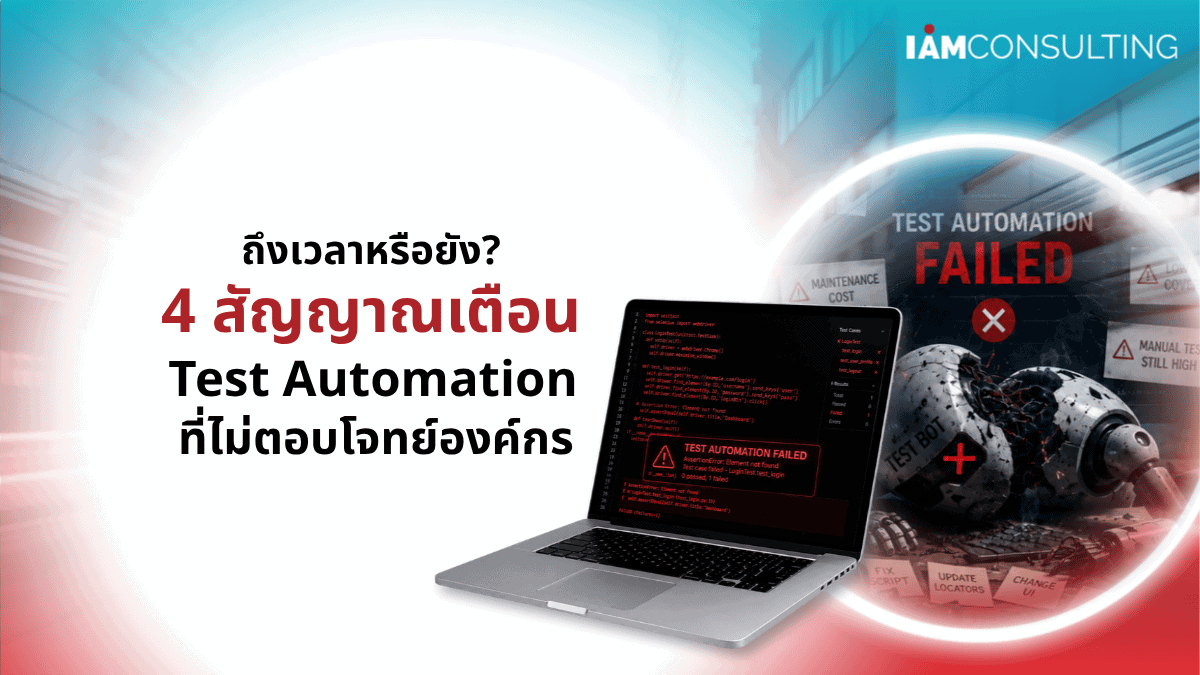
4 Warning Signs Your Test Automation Is Outdated

Many organizations have invested in Test Automation to accelerate software testing, reduce human errors, and increase confidence before deployment or Go-Live. However, the reality is that despite having automated testing in place, many teams still experience slow release cycles, rely heavily on manual testing, and face rising automation maintenance costs year after year.

This is especially true for organizations managing SAP, web, mobile, APIs, and interconnected end-to-end business processes.

It’s time to ask yourself: Is your current Test Automation strategy showing these warning signs?

1. Regression Testing Still Takes Too Long

Even with automation in place, QA teams continue to spend days running regression tests and performing additional manual testing before every Go-Live to ensure system stability.

When regression testing becomes a bottleneck, software releases are delayed, preventing development teams from delivering new features at the speed the business demands.

2. Your QA Team Spends More Time Fixing Test Scripts Than Creating New Tests

This is one of the most common challenges for organizations relying on script-based automation. Whenever the application UI changes or systems are upgraded, test scripts frequently break, forcing QA teams to spend significant time and budget maintaining scripts instead of designing new test cases or improving overall test quality.

3. You Have Thousands of Test Cases, but Still Lack Confidence

Many organizations have accumulated a large number of automated test cases. Yet when it’s time to execute them, teams struggle to determine which tests should run first or which ones are most critical to business operations.

Without risk-based test prioritization, testing becomes time-consuming while business-critical defects can still escape into production.

4. Disconnected Testing Prevents End-to-End Visibility

Enterprise business processes typically span multiple systems, including SAP, web applications, mobile apps, and APIs.

QA teams must consolidate results from multiple sources, making quality management more complex and increasing overall business risk.

Is It Time to Move to Codeless Test Automation?

If your organization is experiencing any of these challenges, it may be a clear sign that your current Test Automation approach is no longer aligned with today’s fast-changing business requirements.

Now is the time to consider Tricentis Tosca, the world’s leading Codeless Test Automation platform designed to transform enterprise testing without requiring code.

Looking for the Right Enterprise Testing Solution?

Choosing a Test Automation platform is about more than simply automating tests. It’s about building a sustainable software delivery process that can adapt to continuous business change.

At I AM Consulting, we help organizations design and implement Enterprise Testing and Test Automation strategies tailored to both SAP and non-SAP environments. Our goal is to help businesses shorten testing cycles, improve software quality, and deliver every deployment with greater confidence.

Experience Tricentis Tosca in Action

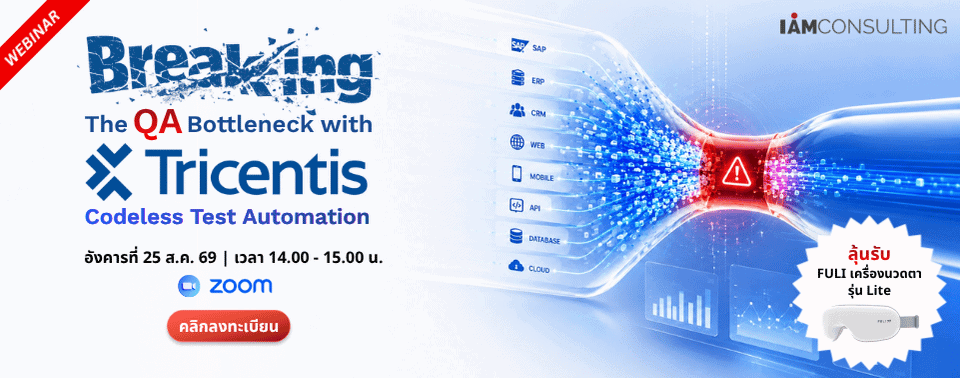
Breaking the QA Bottleneck with Tricentis Codeless Test Automation (Free Webinar)

Join our exclusive webinar to discover how modern Enterprise Testing can dramatically reduce testing time, increase test coverage, and minimize risks across both SAP and non-SAP systems.

You’ll also experience a live demonstration presented by the experts at I AM Consulting.

What You’ll Learn

✅ Explore the key pain points and limitations of traditional Test Automation approaches.

✅ Discover how Tosca solves today’s enterprise testing challenges with a codeless, model-based approach.

✅ Watch a live demonstration covering SAP testing, web application testing, and API simulation.

✅ Learn how organizations can maximize ROI and successfully adopt modern Enterprise Testing.

🗓 Date: Tuesday, August 25, 2026 | 2:00 PM – 3:00 PM

Register for Free 👉 CLICK HERE

(Seats are limited. Registration is required to attend.)

AI Use Cases on SAP That Thai Businesses Are Actually Using

Many organizations have talked about AI for years. But ask “what are you actually using AI for?” and the answer usually ends at a chatbot or a nice-looking dashboard. The truth is that AI use cases on SAP that deliver real business results rarely start with a massive project or a huge budget they start by solving small, everyday problems, such as:

  • Why does the CFO have to wait 7 minutes for a report every morning?
  • Why does the accounting team have to manually type invoice data into SAP?
  • Why do suppliers deliver late with no advance warning?

This article walks through AI use cases on SAP designed by I AM Consulting to solve exactly those problems, covering three core areas of the business, each with a real-world scenario and measurable results.

Why AI on SAP — Not Generic AI?

The difference with AI on SAP is that it accesses real business data directly within SAP S/4HANA. No need to export data first, build extra integrations, or train a model from scratch. SAP Business AI is embedded directly into existing workflows, so users can start immediately without changing their core processes.

Pillar 1: Finance Management — CFOs Decide in 2 Minutes

Finance Management is a use case built for finance executives especially CFOs and Finance Directors who need real-time information to make decisions, rather than waiting for a weekly report.

Real-World Example: Real-Time Cash Flow Analysis

The CFO needs to review liquidity before approving an investment. The finance team has to pull data from multiple SAP modules and export it to Excel for analysis — taking an average of 7 minutes each time.

The CFO types a question in plain language into Joule, such as “Show this month’s cash position compared to last month.” The system pulls data from SAP S/4HANA in real time and returns results with insights within 2 minutes.

75%50%<2 minutes
Reduction in cash flow analysis effortReduction in financial reporting analysis timeTime per cash position check

Profitability Insights and EBITDA Simulation

(EBITDA: earnings before interest, tax, depreciation, and amortization a measure of core business profitability.) Beyond cash flow, AI Finance Management also instantly analyzes profitability by product line, customer segment, or region, and can run simulations such as “If raw material costs rise 15%, how much does that impact EBITDA?” giving CFOs more accurate forward planning.

Pillar 2: Zero Touch Accountant — An Accounting System That Barely Touches a Document

For accounting teams, the most time-consuming work is entering invoice data into the system, matching purchase orders, and fixing errors caused by manual entry. The Zero Touch Accountant concept uses AI on SAP to take over all of that work.

Real-World Example: Automated Invoice Reading with AI + OCR

The accounting team receives 50–200 supplier invoices by email every day. Each one must be opened individually, entered into SAP, checked against the purchase order and goods receipt, and then posted. This process consumes one full-time employee’s entire day.

Invoices are automatically routed into SAP. AI reads the data via OCR, matches it against the PO and GR, verifies accuracy, and posts the entry without any human touch. If something doesn’t match, the system flags it and alerts a staff member to review only the problematic items.

91%500 hours/month
Vendor invoices processed automaticallyTime saved through automation

GR/IR Reconciliation and Faster Period Close

GR/IR reconciliation the accounting team’s nightmare at month-end close is also aided by AI, which analyzes open balances, identifies why postings aren’t clearing, and recommends next steps for staff, instead of requiring line-by-line manual review. This significantly speeds up period close.

Pillar 3: Proactive Supply Chain — Spotting Problems Before They Happen

In supply chain management, most problems don’t appear out of nowhere they happen because no system is reading the warning signs. The Proactive Supply Chain AI use case on SAP shifts organizations from “reacting” to “predicting and preventing.”

Real-World Example: Forecasting Delivery Risk in Advance

The procurement team only learns a supplier is running late after the delivery date has already passed, forcing a scramble for a fix usually expensive and disruptive to the production line.

AI analyzes each supplier’s delivery history, production conditions, and external factors, then provides a 2–4 week advance warning on which POs are at risk of delay. This lets the team line up a backup supplier or adjust the production plan before the problem occurs.

PR Consolidation — Combining Purchase Requests for Greater Negotiating Power

Another AI use case with clear impact is consolidating purchase requests from multiple departments within SAP (PR Consolidation), allowing the procurement team to negotiate with suppliers as a large-volume buyer rather than purchasing piecemeal — reducing costs and shortening lead times.


“What matters isn’t just knowing what AI can do, but designing AI use cases that match the organization’s actual pain points. When AI solves the right problem, it delivers real business results.”

— Sasithorn Sitthikraisorn, I AM Consulting


These three pillars of AI adoption aren’t a future concept they’re capabilities organizations can use today on SAP ERP. The advantage is that organizations already running SAP don’t need to invest in new infrastructure; they simply need to activate the capabilities already embedded in SAP Business AI and design use cases that match their real pain points.

This is exactly what I AM Consulting specializes in. We don’t just demonstrate what AI can do — we help organizations design AI adoption that works in practice, becoming a real driving force behind business decisions and operations.

Get a free consultation with an SAP expert > I AM Consulting

Privacy Overview

This website uses cookies so that we can provide you with the best user experience possible. Cookie information is stored in your browser and performs functions such as recognising you when you return to our website and helping our team to understand which sections of the website you find most interesting and useful.